


Page Under Maintenance
This page is currently under maintenance.
Please communicate at the hospital help desk for assistance.
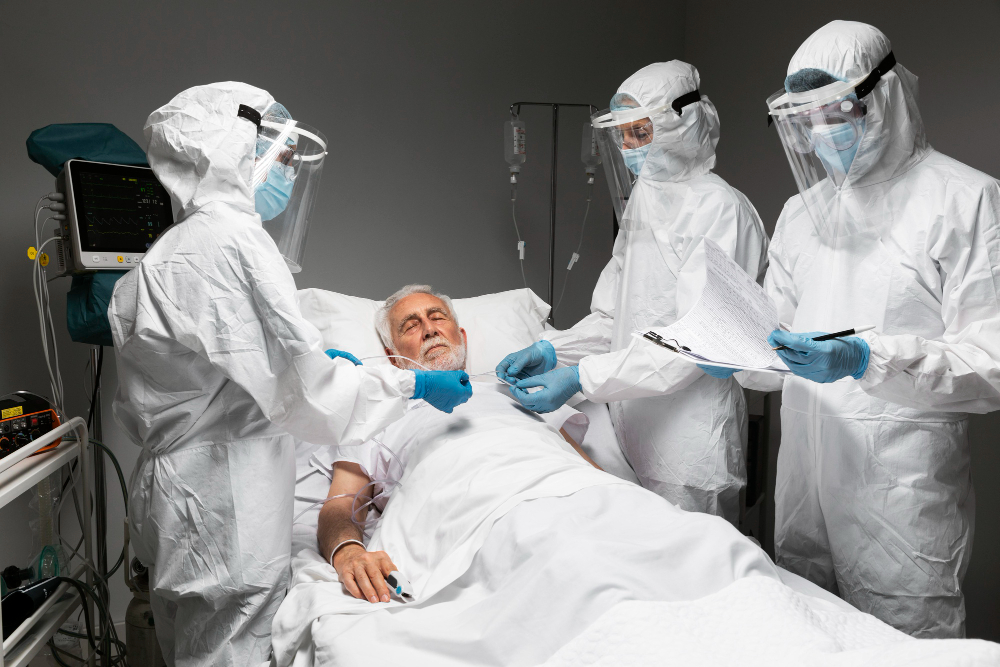
The Intensive Care Unit is medicine's most complex battlefield. Patients arrive gravely ill — their immune defences compromised, their bodies tethered to ventilators, catheters, and intravenous lines. In this environment, a microscopic organism can be just as lethal as the condition that put the patient there in the first place. That is precisely why infection control in the ICU is not a background task — it is the very architecture of patient safety.
30% of HAIs occur in the ICU, despite it housing only ~10% of hospital patients
2–3× higher mortality risk when an ICU patient develops a healthcare-associated infection
70% of HAIs are potentially preventable with rigorous evidence-based protocols
₹1L+ additional cost burden per HAI episode in Indian tertiary care settings
To appreciate the importance of infection control, one must first understand why the ICU is uniquely vulnerable. Critically ill patients are typically immunocompromised — whether from sepsis, trauma, major surgery, organ failure, or aggressive chemotherapy. Their natural defences are weakened at precisely the moment they are most exposed to invasive procedures.
Every catheter inserted, every ventilator connected, and every surgical drain placed creates a direct pathway for microorganisms to bypass the body's protective barriers. The warm, moist environment of a busy ICU, combined with the heavy and often prolonged use of broad-spectrum antibiotics, creates conditions in which drug-resistant pathogens can thrive and spread with alarming ease.
Healthcare-associated infections (HAIs) — infections acquired in a hospital setting — are a global crisis. In ICUs specifically, the most dangerous are ventilator-associated pneumonia (VAP), catheter-associated urinary tract infections (CAUTI), central line-associated bloodstream infections (CLABSI), and surgical site infections (SSI). Each of these carries the potential to extend a patient's hospital stay by days or weeks, escalate treatment costs dramatically, and in the most tragic cases, prove fatal.
HAIs in the ICU arise from multiple sources: the patient's own microbiome (endogenous infections), contaminated hands of healthcare workers, improperly sterilised equipment, airborne droplets, and environmental surfaces harbouring resilient pathogens like Klebsiella pneumoniae, Acinetobacter baumannii, methicillin-resistant Staphylococcus aureus (MRSA), and carbapenem-resistant Enterobacteriaceae (CRE).
What makes these infections particularly dangerous is the growing phenomenon of antimicrobial resistance (AMR). Patients in the ICU receive more antibiotics than virtually any other patient population. When those antibiotics are used without strict stewardship, they accelerate the selection of resistant strains — leaving clinicians with fewer and fewer effective treatment options. An infection that might be manageable in a general ward can become life-threatening in a patient already fighting for survival in the ICU.
In critical care, preventing an infection is infinitely more powerful than treating one. Every hand washed, every bundle followed, every surface disinfected is a life defended before the threat ever arrives.
— Critical Care & Infection Control Team, Jaslok Hospital
At Jaslok Hospital, infection control in the ICU is not a single intervention — it is a continuous, multi-layered strategy built on evidence-based best practices and led by a dedicated Infection Control Committee that monitors, audits, and refines protocols regularly. Below are the foundational pillars that make this possible.
The World Health Organization identifies hand hygiene as the single most important intervention to prevent HAIs. Our ICU teams practise the WHO's Five Moments of Hand Hygiene: before patient contact, before aseptic procedures, after body fluid exposure, after patient contact, and after touching the patient's surroundings. Alcohol-based hand rubs are positioned at every bedside and every workstation to eliminate barriers to compliance.
Evidence-based care bundles — structured sets of practices implemented together — have been proven to dramatically reduce VAP, CLABSI, and CAUTI rates. The VAP bundle, for instance, includes daily sedation vacations, head-of-bed elevation, oral care with chlorhexidine, and prophylaxis against peptic ulcers and deep vein thrombosis. These bundles are non-negotiable in our ICU protocols.
High-touch surfaces in the ICU — bedrails, monitor controls, infusion pump buttons, door handles — can harbour pathogens for hours to days. Our housekeeping teams are trained in systematic terminal and daily cleaning protocols using hospital-grade disinfectants. Advanced technologies including UV-C disinfection robots are used periodically for deep decontamination.
Patients colonised or infected with drug-resistant organisms are placed under contact precautions and, where necessary, isolated in single-room units. Barrier precautions including gloves, gowns, and in some cases masks are mandatory. Cohorting of affected patients and dedicated nursing staff minimises the risk of cross-transmission within the unit.
Our ICU operates under a formal Antimicrobial Stewardship Programme (AMSP), where every antibiotic prescription is reviewed for appropriateness, spectrum, dose, and duration. De-escalation — narrowing therapy once culture results are available — is practiced diligently to preserve the efficacy of existing antibiotics and prevent the emergence of resistance.
What gets measured gets managed. Our Infection Control Team performs active surveillance of HAI rates, tracks trends in microbial isolates, and monitors resistance patterns in real time. Root cause analyses are conducted for every HAI episode to identify systemic gaps and drive continuous improvement.
Protocols are only as strong as the people who follow them. Infection control in the ICU is ultimately a human endeavour — it depends on the discipline, vigilance, and commitment of every single person who enters the unit, from senior consultants to nursing staff to support personnel.
At Jaslok Hospital, this begins with rigorous onboarding training for all ICU staff and continues with regular simulation drills, competency assessments, and refresher workshops. We believe in creating a culture of psychological safety where any team member — regardless of seniority — can speak up about a protocol lapse without fear of reprisal. A nurse who reminds a consultant to sanitise their hands before examining a patient is not being insubordinate; they are being a patient's advocate.
Family members and visitors also play a role. We provide clear, compassionate guidance to ICU visitors on hand hygiene, protective equipment, and the importance of not bringing personal items — including food and flowers — into the unit.
Jaslok ICU Infection Control: Key Commitments
It is easy to frame infection control in clinical or operational terms — reduced mortality, shorter stays, lower costs, better outcomes. All of these are true and important. But there is a more fundamental framing: every patient admitted to an ICU has a right to receive care in an environment that does not itself become a source of harm.
A patient who enters Jaslok Hospital's ICU after a cardiac event, a major surgery, or a severe illness places profound trust in us. They are often unable to advocate for themselves. They cannot see whether hands were washed before a line was accessed, or whether the surface beside their bed was properly cleaned. They depend entirely on the integrity of the systems and people around them. Infection control is how we honour that trust.
It is also worth noting that the cost of a HAI extends beyond the individual. Resistant organisms acquired in one patient can spread to others; outbreaks in ICUs have, in rare cases, led to ward closures. Every infection prevented protects not just one patient but the entire ecosystem of vulnerable individuals within the hospital.
The science of infection control continues to evolve rapidly. Emerging technologies are beginning to complement traditional practices in meaningful ways. Whole-genome sequencing of pathogens now allows hospitals to trace the precise transmission chain of an outbreak, enabling targeted interventions rather than broad responses. Artificial intelligence tools are being developed to predict which ICU patients are at highest risk of developing a HAI, enabling pre-emptive measures. Copper-infused surfaces and antimicrobial coatings for high-touch areas are under active investigation in hospital settings globally.
At Jaslok Hospital, we are committed to staying at the forefront of these advances — integrating new evidence into practice as it emerges, investing in training and technology, and benchmarking our infection rates against the best centres in India and the world. Our aspiration is not merely to meet accepted standards, but to set them.
Related Blog:- https://jaslokhospital.net/blogs/what-is-critical-care-a-complete-patient-family-guide-to-icu-care
The ICU represents medicine at its most intense — where the margin between recovery and deterioration is often measured in hours, and where every decision carries profound consequence. In this environment, infection control is not simply one item on a checklist; it is the foundation on which everything else is built. Without it, even the most advanced ventilators, the most potent medications, and the most skilled surgeons cannot deliver on their promise.
At Jaslok Hospital, we view infection control as a shared responsibility — one that belongs to every doctor, nurse, technician, and support staff member, every visitor, and the institution as a whole. It is a covenant we make with every patient: that while you are in our care, we will do everything within our power to keep you safe — not just from the illness that brought you here, but from every preventable threat that could arise within these walls.
Because at the end of the day, the most effective treatment we can offer is the one that never has to happen — the infection we prevented before it began.