

Page Under Maintenance
This page is currently under maintenance.
Please communicate at the hospital help desk for assistance.
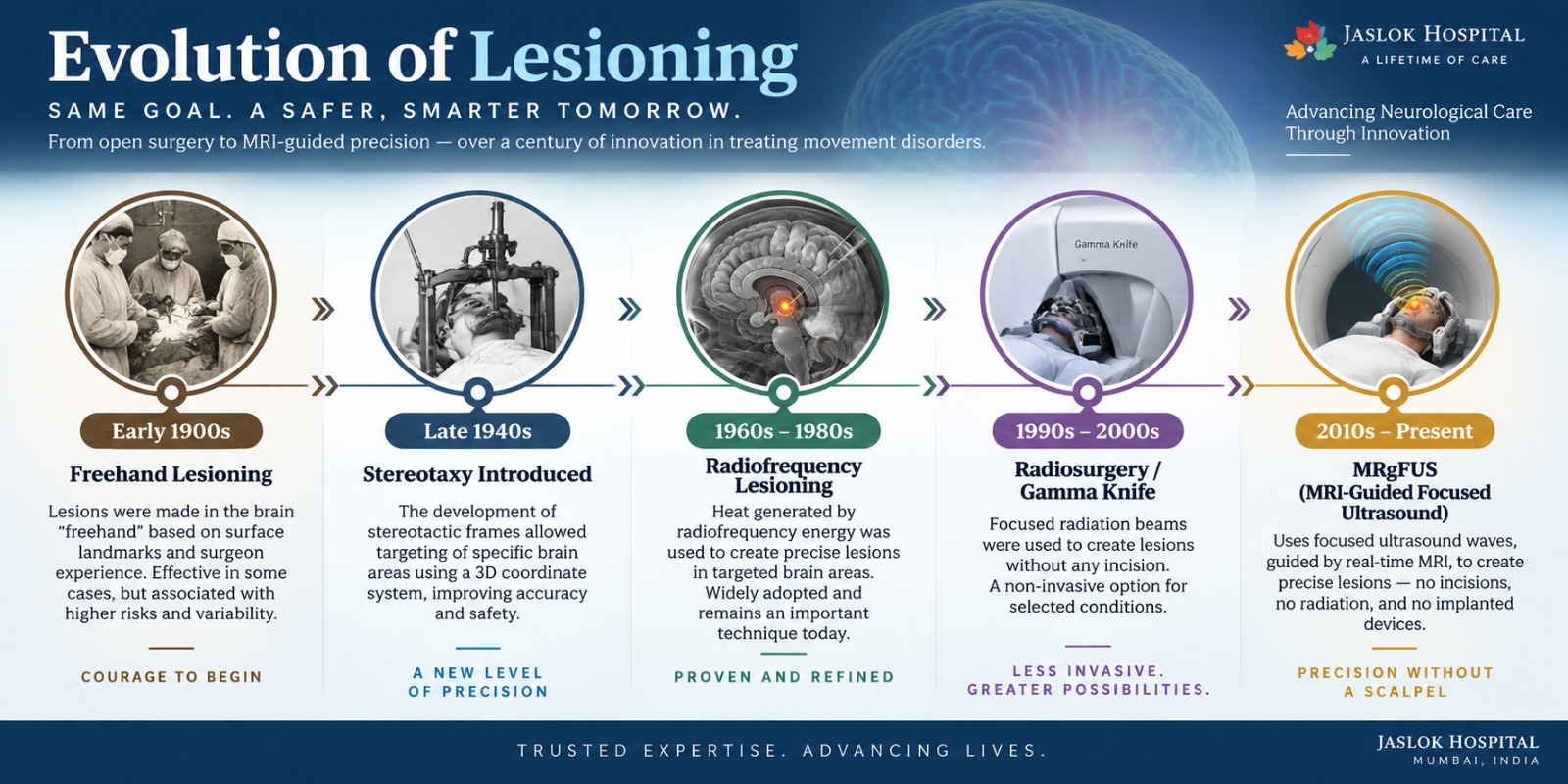
1. A new technology, built on an established principle. MRgFUS uses focused ultrasound to create a precise, permanent brain lesion without incisions or implants. The underlying principle of lesioning has been used in functional neurosurgery for decades.
2. Jaslok’s 30-year experience in lesioning matters. Since 1998, Jaslok has developed extensive experience in radiofrequency lesioning across movement disorders, psychiatric conditions and pain, providing a foundation for understanding lesion-based treatments.
3. The right treatment depends on the individual patient. MRgFUS offers incisionless treatment, but its effects are irreversible and bilateral treatment carries additional risks. DBS offers adjustability and reversibility, making specialist assessment essential when choosing between treatment options.
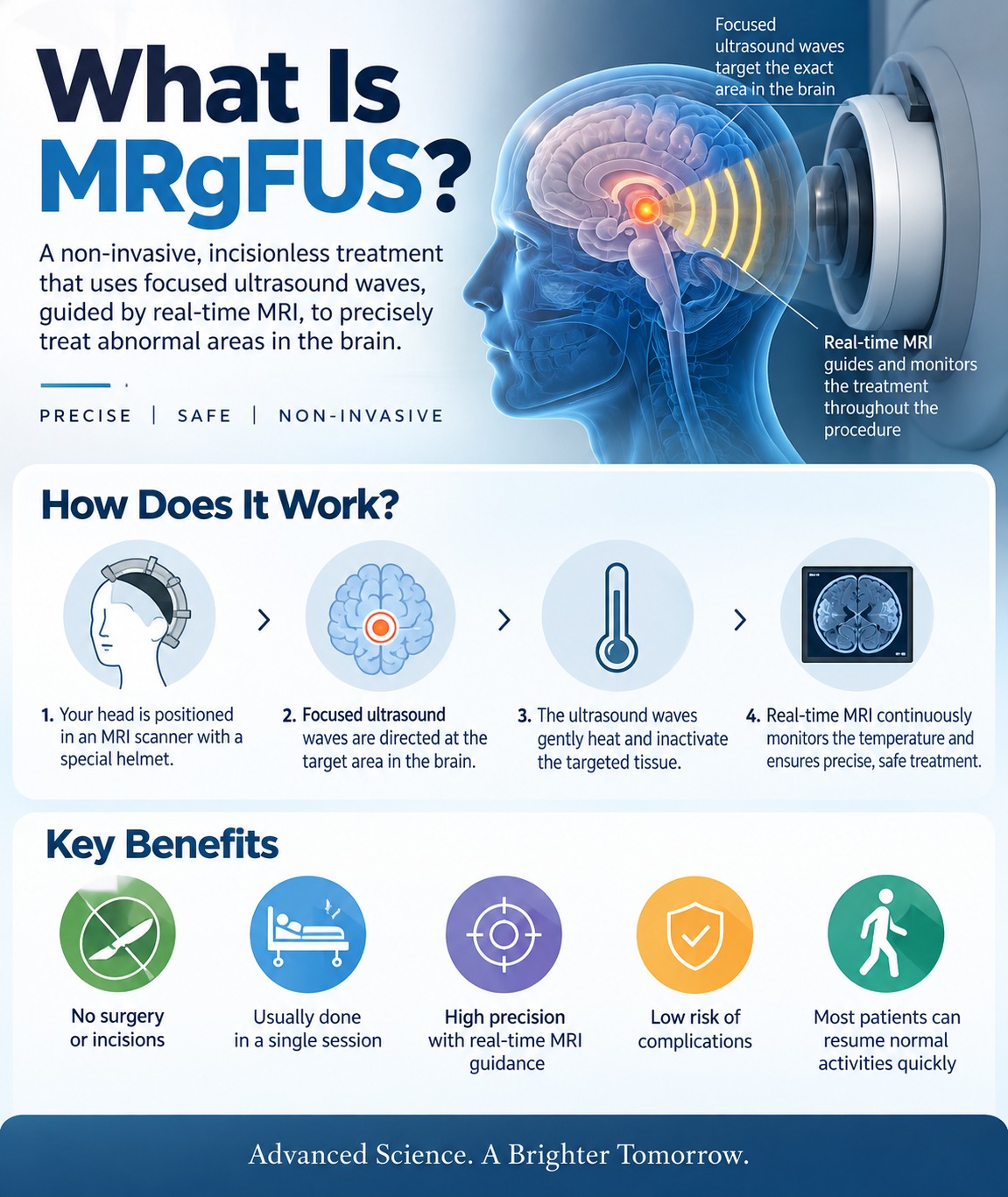
Magnetic Resonance-guided Focused Ultrasound, or MRgFUS, is one of the newest tools available for treating tremor and related movement disorders — and one of the least invasive. During the procedure, a helmet-like array of more than a thousand individual ultrasound transducers is placed around the patient's head. Each transducer sends a low-energy beam of ultrasound through the intact skull; on its own, none of these beams does anything to the brain. It is only where all of them converge — a single point, often just a few millimetres across, deep inside the brain — that their combined energy is strong enough to heat the tissue and create a small, permanent, therapeutic lesion.
The entire procedure is performed inside an MRI scanner, which does two things at once: it lets the treating team see exactly where the ultrasound beams are converging in real time, and it measures the temperature at that point to the degree, so the lesion can be built up gradually, in careful increments, rather than in one step. Because the patient stays awake throughout, tremor, speech and strength can all be tested between increments — confirming the desired effect, or stopping immediately if anything unwanted is noticed, before the lesion is made permanent.
There is no incision, no drilling, and no implanted hardware, and typically no overnight hospital stay. For the right patient, that makes MRgFUS an appealing option. But as the rest of this page explains, “no incision” is not the same as “new science” — the therapeutic principle behind MRgFUS has been part of neurosurgery for close to a century.
What actually treats the tremor in MRgFUS is not the ultrasound itself — it's the lesion the ultrasound creates. A small, permanent, controlled injury at a precise point deep in the brain, placed exactly where overactive signalling is driving the tremor or rigidity, interrupts that faulty circuit. This is called lesioning — and, said plainly, it means deliberately destroying a very small, carefully chosen part of the brain.
Put that directly, and it sounds alarming. It shouldn't. Lesioning has been a deliberate, closely studied part of functional neurosurgery for close to a hundred years, refined across generations of neurosurgeons specifically to make it as safe and as precise as possible. What has changed over that century is not the underlying idea — it is the tool used to make the lesion.
The earliest deliberate brain lesions for movement disorders date to the early 1900s, made freehand, with all the imprecision that implies. That changed with the development of stereotaxy in the late 1940s — a system of three-dimensional coordinates and a rigid head frame that let a surgeon aim at a specific point deep in the brain to within a millimetre, without seeing it directly. Stereotaxy made two further generations of lesioning possible: radiofrequency (RF) lesioning, which uses a fine electrode to heat and destroy tissue at the target — and can be tested electrically before the final lesion is made; and, later, radiosurgery, using tightly focused beams of radiation aimed through the intact skull to create the same kind of lesion without ever inserting an electrode. A single centre in Marseilles, France, has performed over 1,000 such incisionless lesioning procedures using Gamma Knife radiosurgery for tremor and other functional disorders — a body of experience built up over more than two decades (see citation below).
MRgFUS is the newest entrant in that same lineage: a fourth way, after freehand surgery, RF, and radiosurgery, of making the same kind of therapeutic lesion — this time using focused ultrasound instead of radiation or an electrode.
At Jaslok Hospital, we have been practising lesioning surgery for the last 30 years, since 1998 — the same year our Deep Brain Stimulation programme began. Over that time we have built one of India's most extensively published lesioning experience records, across radiofrequency thalamotomy, pallidotomy, subthalamotomy and capsulotomy, spanning movement disorders — Parkinson's disease, essential tremor, and dystonia — as well as psychiatric disorders such as obsessive-compulsive disorder, and pain.
A few figures from that published experience: in our largest published series (107 cases), thalamotomy improved tremor scores by 74% in Parkinson's disease; pallidotomy improved contralateral motor scores and dyskinesia by 41% and 57% respectively at one year; subthalamotomy improved total and motor UPDRS scores by roughly 31–32% at two years; writer's cramp (task-specific dystonia) rating scores improved from 10.54 to 1.6, with 9 of 13 patients reaching complete resolution; and every patient treated for OCD was in remission at follow-up, with Yale-Brown scores improving from 36.5 to 8.2.
Doshi PK. Radiofrequency Lesioning for Movement and Psychiatric Disorders — Experience of 107 Cases. Front Hum Neurosci. 2021;15:673848. doi:10.3389/fnhum.2021.673848
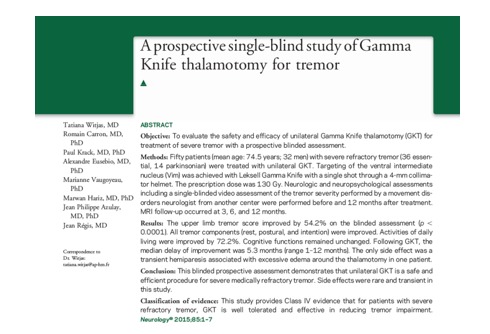
Witjas T, Carron R, Krack P, et al. A prospective single-blind study of Gamma Knife thalamotomy for tremor. Neurology. 2015. doi:10.1212/WNL.0000000000002087 (Marseilles group, cited in text for gamma knife lesioning volume)
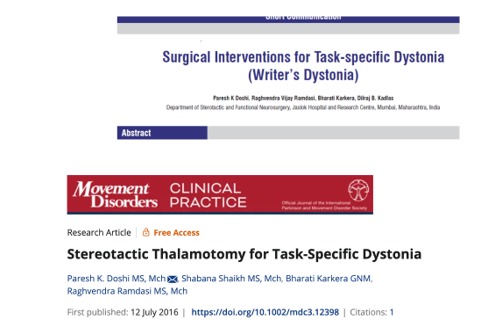
Doshi PK, Ramdasi RV, Karkera B, Kadlas DB. Surgical Interventions for Task-specific Dystonia (Writer's Dystonia). Ann Indian Acad Neurol. 2017. doi:10.4103/aian.AIAN_15_17 — and — Doshi PK, Shaikh S, Karkera B, Ramdasi R. Stereotactic Thalamotomy for Task-Specific Dystonia. Mov Disord Clin Pract. 2016. doi:10.1002/mdc3.12398
https://pmc.ncbi.nlm.nih.gov/articles/PMC3221188/
Doshi PK. Anterior capsulotomy for refractory OCD: First case as per the core group guidelines. [Journal, year and DOI not legible in source clipping — confirm exact citation before this goes live.]
Doshi PK, Baldia M, Mulroy E, Krauss J, Bhatia K. Outcomes of Unilateral Pallidotomy in Focal and Hemidystonia Cases: A Single-Blind Cohort Study. Mov Disord Clin Pract. 2024. doi:10.1002/mdc3.13912
RF lesioning — the technique this published experience was built on — and MRgFUS achieve the same kind of therapeutic effect. But RF lesioning has three practical advantages worth knowing about.
Practically, RF lesioning is also available at a fraction of the capital and per-procedure cost of MRgFUS — which matters for access, and is part of why Jaslok has been able to offer lesioning across such a broad range of conditions, from movement disorders to psychiatric disorders to pain, rather than for tremor alone.
None of this makes MRgFUS the wrong choice — it has real advantages of its own, covered in the FAQ below. But it is worth understanding it for what it is: a genuinely new way of delivering a treatment principle Jaslok's team has been refining, publishing and using safely for three decades — old wine in a new, and very well-engineered, bottle.
MRgFUS's approved use in Parkinson's disease has expanded in stages — and it's worth understanding those stages, because they define who is currently a candidate.
The first approval, in 2018, covered only one specific, narrow group: patients with tremor-dominant Parkinson's disease, treated on one side of the brain only (a single lesion in the VIM nucleus of the thalamus), for tremor alone. Rigidity, slowness and dyskinesia — the other major motor symptoms of Parkinson's — were not addressed by this original approval, and patients with those symptoms as their primary problem were not good candidates.
That changed in November 2021, when approval expanded to a different, deeper target — the pallidothalamic tract, closely related to the pallidotomy target RF lesioning has used for decades — specifically to address the broader motor picture of more advanced Parkinson's disease: rigidity, motor fluctuations and dyskinesia, not just tremor. This meaningfully widened who MRgFUS could help.
The most recent expansion allows staged bilateral treatment — both sides of the brain treated with MRgFUS, in two separate sessions at least six months apart, rather than being limited to one side for life. Historically, unilateral treatment was the rule for incisionless lesioning procedures generally, out of caution around treating both sides of the brain at once or in close succession. The FAQ below goes into why this bilateral expansion, specifically, is a live debate rather than a settled matter.
The questions below are the ones patients actually search for and ask in clinic — compiled from common patient questions plus Paresh's own priority questions, with his direct answers where the question called for clinical judgment rather than a plain fact.
Who is a candidate for MRgFUS?
Adults with essential tremor or tremor-dominant Parkinson's disease whose tremor hasn't responded adequately to medication, who don't have an MRI-incompatible implant, and whose skull passes a density screening test (see below). Final eligibility is always a case-by-case call after imaging and specialist assessment.
How effective is it, and how much improvement can I expect?
In the pivotal trials, hand tremor scores improved 47% (essential tremor, at 3 months) and 62% (tremor-dominant Parkinson's, at 3 months) in treated patients, against near-zero change with sham treatment. These are trial averages, not a promise for any one patient.
NEJM 2016; JAMA Neurol 2018
How long do the results last, and is it a permanent cure?
This depends on the indication. For essential tremor, results can be long-lasting — a 5-year follow-up has shown 73% improvement maintained. Long-term follow-up for parkinsonian tremor isn't available yet, and it's worth noting that Parkinson's is a progressive disorder: although tremor may be the most disturbing initial symptom, it typically isn't what most affects a Parkinson's patient's quality of life after five years — and certainly not after ten — with some exceptions. As the disease progresses, symptoms can return, and a one-time MRgFUS procedure may not be a permanent answer. The Parkinson's trials available so far are also still short-term.
5-year follow-up data (essential tremor); long-term Parkinson's follow-up not yet available
What happens during the procedure — will I be awake?
Yes, throughout, because the team needs to test tremor, speech and strength after each pulse of ultrasound to confirm the desired effect before the lesion is made permanent. The session typically runs 2.5–4 hours on the table; it's generally well tolerated, though the head frame and scalp warming can be uncomfortable.
What are the risks and side effects?
The most common are transient — headache, dizziness, brief numbness — but not all resolve: in trial data, a meaningful minority of patients had persistent finger or facial numbness, or balance difficulty, at 3–12 months. Because the lesion is permanent, these effects can't be “turned down” the way a DBS side effect can. The risks increase when the procedure is performed bilaterally, notable ones are, speech disturbances and balance and walking issues. To know more visit our Blog
NEJM 2016; JAMA Neurol 2018
How long is recovery?
Most patients go home the same day or next and resume daily activities within days, though balance can take a month or more to fully settle — driving and swimming alone are usually discouraged until a clinician confirms it's safe.
MRgFUS vs DBS — how do I choose?
This is a genuinely interesting question, and there's no single answer — the right choice depends on several factors, starting with the diagnosis and the treatment goal. For essential tremor, both options are reasonably good, with perhaps a slight tilt toward MRgFUS. For Parkinsonian tremor, it depends on how long the tremor has been present: if it's been more than five to seven years, isn't responding to medical treatment, is the patient's main disabling symptom, and there's very little accompanying rigidity, bradykinesia or gait difficulty, MRgFUS may be a reasonable choice for a patient who doesn't want DBS — but this kind of patient is genuinely rare. Most people with Parkinson's disease have bilateral tremor, on both sides, along with other, often more disabling symptoms — motor fluctuations, off periods, dyskinesia. Because Parkinson's is progressive, a one-time MRgFUS procedure won't solve the problem forever. The better fit, in that case, is usually a treatment that behaves the way medication does — something that can be adjusted and titrated as the disease and side effects change over the years a patient has already been living with it. When considering any surgical option, the questions worth asking are the same: is it reversible, the way stopping or changing a medicine is if there's a side effect? Is it titratable? Can it be tailored differently for different patients, rather than one size fits all? Do we have long-term follow-up? At present, the only procedure that answers yes to all four is Deep Brain Stimulation. If that's raised more questions than it's answered, that's exactly the conversation worth having directly with a movement disorder specialist.
The Scandinavian Movement Disorder Society's own consensus, summarised:
Source: ScandMODIS consensus, April 2025 — https://www.swemodis.se/wp-content/uploads/2026/01/MRgFUS-Consensus-ScandMODIS-2025.pdf
The US FDA has approved MRgFUS for bilateral Parkinson's disease — isn't FDA approval itself a strong endorsement? What's the concern?
FDA approval is generally a strong signal that a treatment's benefits reasonably outweigh its risks — but in this specific case, the sequence of events is worth knowing. The bilateral approval was granted before the full results of the bilateral pallidothalamic tractotomy (PTT) trial were published: FDA approval came in July 2025, while the trial's full peer-reviewed results weren't published until roughly a year later, in mid-2026.
When those results did appear, the publishing journal's own summary noted: “Unilateral MRgFUS pallidothalamic tractotomy offers an effective incisionless treatment for Parkinson's disease patients with motor complications, showing excellent safety and sustained motor benefit. However, the cumulative burden of bilateral ablation has a higher risk of persistent speech, gait, and balance complications (25% with moderate or severe events at 12 months vs 2?ter unilateral treatment) with only small additional motor benefit observed in this study beyond the unilateral plateau. These findings echo historical lessons from bilateral radiofrequency ablation and emphasise the need for judicious patient selection and thorough counselling regarding irreversible bilateral lesion risks.”
Two independent expert voices raised the same concern directly.
Stereotact Funct Neurosurg (2026) 104(2):147–149. doi:10.1159/000548824
“the results did not support routine use of bilateral FUS for PTT,”
that DBS “permits titration of stimulation to minimise side-effects… an option unavailable after ablation,”
and that “the role of staged bilateral FUS PTT remains uncertain.”
Lancet Neurol. 2026 Jul;25(7):619–621. doi:10.1016/S1474-4422(26)00212-7
Can I have DBS after MRgFUS?
Yes — a recent case series of 8 patients found this sequence safe and effective, with a 70.7% further reduction in tremor scores after DBS was added, most often for tremor recurrence or symptoms on the untreated side.
One more point in the same vein — cost is another reason MRgFUS isn't always the complete answer:
What does it cost?
Published estimates put private-hospital MRgFUS pricing in India at roughly ₹15–20 lakh per side — nearly double what DBS costs. Insurance coverage varies by policy and should be confirmed directly with the provider.
MRgFUS is a genuine technical achievement — a way of making a century-old kind of therapeutic brain lesion without ever opening the skull. That's worth taking seriously, and worth offering to the right patient. It is not, on the evidence available today, a wholesale replacement for Deep Brain Stimulation, and it is not a cure for either essential tremor or Parkinson's disease. The honest picture, drawn from the same trials and expert commentary above, is closer to this: promising, real, still accumulating evidence — and best chosen deliberately, for the patient it actually fits, rather than by default.