


Page Under Maintenance
This page is currently under maintenance.
Please communicate at the hospital help desk for assistance.
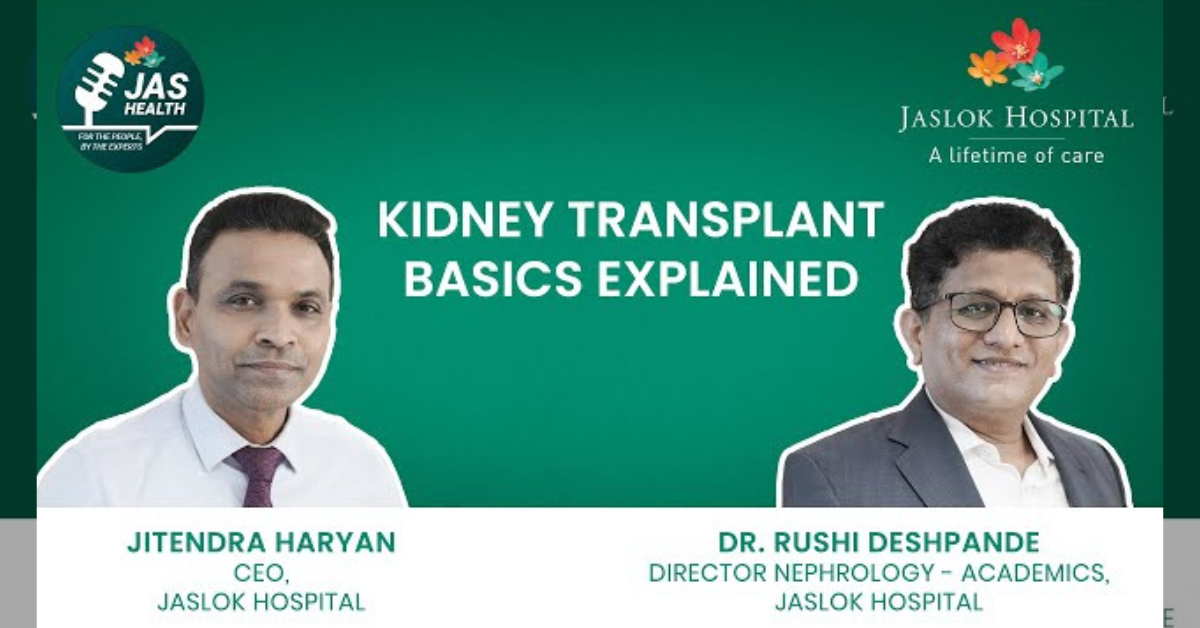
A kidney transplant decision brings up countless questions for both patients and potential donors. In this episode of Just Health for the People, a public health awareness initiative by Jaslok Hospital, host Jitendra Hariyan speaks with Dr. Rishi Deshpande, Director of Nephrology Academics at Jaslok Hospital, to address some of the most important and commonly asked questions around kidney transplantation.
Dr. Deshpande is a gold medalist in DNB Nephrology, completed his clinical fellowship at the University of Toronto, and brings over 25 years of experience along with memberships in several national and international nephrology societies.
A kidney transplant is a surgical procedure in which a healthy kidney from a donor is implanted into a patient suffering from kidney failure, replacing the function of the patient's failed kidneys.
Kidney failure falls into two categories:
Patients at this stage benefit significantly from transplantation.
There are two main types:
Medically, anyone who is fit and has two healthy kidneys can donate. However, India's Human Organ Transplant Act strictly prohibits any commercial activity related to kidney transplantation. As a result, donations are legally permitted only from donors who are near relatives donating out of love and affection, unless the relationship can be clearly established.
Unrelated kidney donation is not medically challenging but is legally complex, since it's difficult for any committee to verify that no commercial transaction was involved. Jaslok Hospital generally discourages unrelated donations unless a court of law has verified that the donation is genuinely motivated by love and affection and grants explicit permission.
For patients in urgent need of a kidney without a willing living donor, Dr. Deshpande outlines the available paths:
Transplantation is generally recommended over long-term dialysis because transplant patients tend to live longer and experience a significantly improved quality of life, work capacity, and ability to support their families compared to those remaining on dialysis.
Dr. Deshpande distinguishes between biological age and chronological age — some individuals age faster or slower than their actual years would suggest. He shares an example of performing India's first older-donor transplant in 2008, involving a 76-year-old female donor (above the Human Organ Transplant Act's upper limit of 75 at the time). Remarkably, that donor, now 93 years old, remains alive and healthy 17 years later. Suitability for donation is ultimately determined through comprehensive medical evaluation, not age alone.
Matching blood groups is increasingly considered an outdated requirement. Since 2008, Jaslok Hospital has been regularly performing blood group-incompatible transplants, with excellent success rates — roughly one in three transplants performed at the hospital today are across blood groups, with outcomes on follow-up performing equally well as matched transplants.
Dr. Deshpande explains that pre-transplant evaluation serves three key purposes:
Living donors face standard surgical and anesthesia-related risks, though these are considered very small in modern medical practice — comparable to the risk profile of an appendix or hernia surgery. The donor surgery itself is called a nephrectomy.
Recovery timeline for donors:
Dr. Deshpande acknowledges this is one of the toughest emotional decisions a person can face, and the courage to donate typically stems from love for the patient. From a medical standpoint, evaluation processes provide over 99% confidence that a donor will not become a kidney patient themselves as a result of donating.
While organ transplantation between individuals is inherently complex, modern medicine has made it remarkably successful. Key statistics shared by Dr. Deshpande:
Post-transplant care today is highly personalized, with immunosuppressive medication regimens designed to minimize side effects while maximizing long-term benefit.
Because finding a perfect immunological match would require screening thousands of donors (roughly a 1-in-7,000 chance), lifelong medication is essentially unavoidable for nearly all transplant recipients — except in extremely rare cases involving an identical twin donor. Patients are counseled clearly before transplant that consistent, lifelong medication adherence is a firm commitment.
Strict isolation is considered a somewhat outdated concept today, as most post-transplant infections stem from conditions already present in the patient (such as tuberculosis or CMV) rather than new environmental exposure. However, during the first month to six weeks — when immunosuppressive medication doses are highest — patients are advised to avoid crowds and close contact with infected individuals. Long-term, patients are advised to maintain general food and water hygiene precautions for life.
Jaslok Hospital holds a distinguished legacy in kidney transplantation, including performing India's first private-sector kidney transplant, the country's first blood group-incompatible transplant, and the first HIV-positive kidney transplant. The hospital performs 150–200 transplants annually, among the highest volumes in the private sector in Western India, with excellent long-term survival outcomes.
Dr. Deshpande emphasizes that successful transplantation relies on a multidisciplinary approach — involving nephrologists, transplant surgeons, anesthetists, cardiologists, and other specialists as needed, all available under one roof.
For patients with a willing living donor whose blood group doesn't match (and who prefer not to pursue a blood-group-incompatible transplant), swap transplantation offers another pathway. In a swap, two donor-recipient pairs with complementary but mismatched blood groups exchange donors — for example, a donor with blood group B matched to a recipient needing group A pairs with a reciprocal donor-recipient pair. When more than two pairs are involved in a chain exchange, it's referred to as a domino transplant.
Jaslok Hospital maintains a swap registry, where nephrologists log patient data to identify compatible matches across the hospital's patient pool, significantly expanding donor options for patients.
Dr. Deshpande's advice for maintaining healthy kidneys includes:
Based on long-term data from donors who gave a kidney 30–40 years ago and continue to live completely normal, healthy lives, Dr. Deshpande confirms that one healthy kidney is sufficient for a normal, healthy life for the vast majority of donors — reassuring news for both prospective donors and recipients, who often carry guilt about the impact of their decision on a loved one.
This article is based on an episode of Just Health for the People, a public health awareness initiative by Jaslok Hospital, featuring Dr. Rishi Deshpande, Director of Nephrology Academics. Watch the full video here: Kidney Transplant Explained by Dr. Rishi Deshpande
For consultation regarding kidney health, transplant eligibility, or donor evaluation, please reach out to Jaslok Hospital's Department of Nephrology.