


Page Under Maintenance
This page is currently under maintenance.
Please communicate at the hospital help desk for assistance.
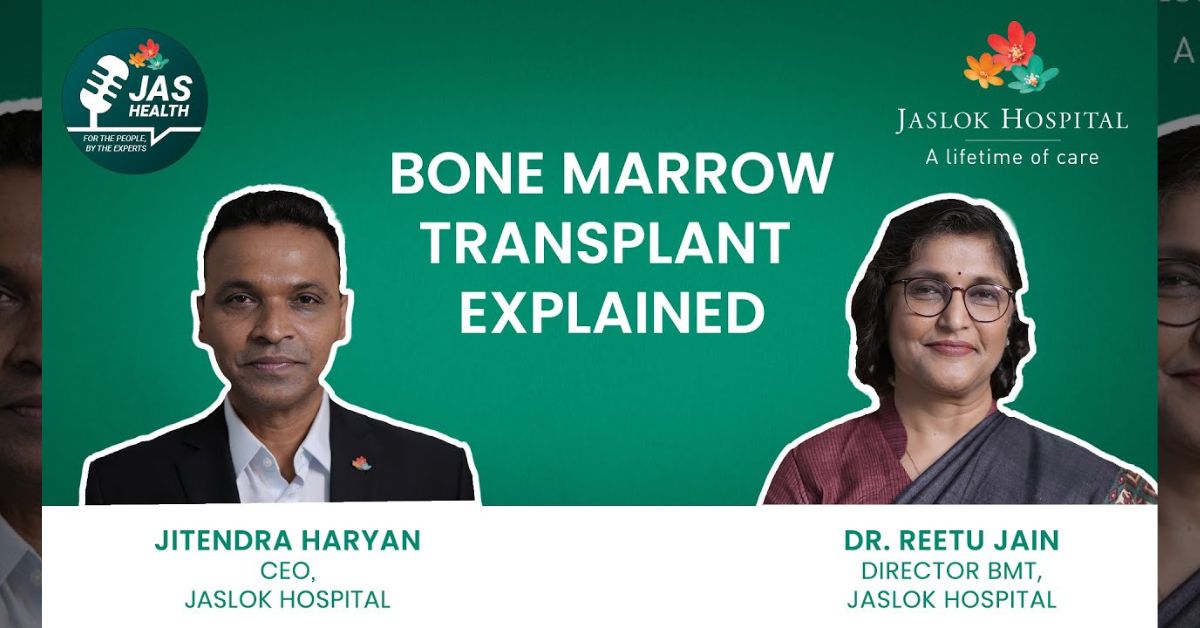
Bone marrow transplant is one of the most life-changing procedures in modern medicine — and also one of the most misunderstood. In this episode of Just Health for the People, a public health awareness initiative by Jaslok Hospital, host Jitendra Hariyan speaks with Dr. Ritu Jain, Director of the Bone Marrow Transplant Department at Jaslok Hospital, whose center is one of the leading private-sector bone marrow transplant units in Western India, having performed over 675 transplants to date.
Bone marrow is a liquid substance found inside our bones — particularly at the ends of long bones — responsible for producing hemoglobin, white blood cells, and platelets. Just as we transplant a failing organ like a liver, kidney, or heart, a bone marrow transplant replaces a patient's non-functioning bone marrow with healthy marrow or stem cells, either from the patient themselves or from a donor. It is considered a curative procedure for patients with blood cancers or bone marrow failure who have no other treatment options left.
This procedure is offered to both children and adults, depending on the underlying condition:
In children:
In adults:
Dr. Jain clarifies that "bone marrow transplant" is now somewhat of an outdated term. Since stem cells can be collected directly from blood rather than the bone marrow itself, the medical community now refers to this procedure as stem cell transplant.
The patient's own stem cells are collected beforehand, followed by high-dose chemotherapy, after which the collected stem cells are given back to help the bone marrow recover quickly. Technically, this isn't a "transplant" in the traditional sense since no donor is involved — it's used to speed up bone marrow recovery after intensive chemotherapy.
This requires a donor and includes several subtypes:
Stem cells collected from the placenta and umbilical cord after childbirth represent the purest form of stem cells. However, due to limited quantity, this option is generally viable only for pediatric patients and has become less commonly used in recent years.
Dr. Jain notes that autologous and allogeneic transplants remain the two main forms of transplant therapy offered today.
Just as everyone has a blood group, each person also has a unique HLA (Human Leukocyte Antigen) type, inherited 50% from each parent. This is why full siblings have roughly a 25% chance of being a complete match, while parents or children typically share a 50% match. HLA typing can be done via blood or saliva samples and is a prerequisite before identifying a suitable donor.
Contrary to popular belief (often shaped by misinformation on social media), the procedure does not involve any surgery or operating theatre in most modern cases. Here's how it typically works:
After the stem cell infusion, the most critical and potentially life-threatening phase begins, as the patient's white blood cells and platelets drop to near zero following high-dose chemotherapy. The infused stem cells gradually establish a new, functioning bone marrow — a process that typically unfolds over about three weeks:
Typical hospital stay: 2–3 weeks (allogeneic), slightly shorter for autologous transplants (around 2–2.5 weeks), followed by 3 months of outpatient follow-up.
Dr. Jain outlines the main categories of risk:
Unlike solid organ transplants (liver, kidney), which carry an ongoing lifelong risk of rejection requiring permanent immunosuppressive medication, bone marrow transplant patients typically require immunosuppressive drugs for only six months to a year, after which most patients are gradually weaned off. Dr. Jain refers to this as a "liquid transplant," distinct from solid organ transplantation.
Patients with more severe forms of GVHD (affecting eyes, mouth, or lungs) may require longer-term medication — sometimes 3–5 years, and occasionally lifelong steroids — though this applies to a minority of patients.
Roughly 15–20% of patients face a risk of relapse after transplant, with the risk being significantly lower when the transplant is performed at an earlier disease stage compared to a later, more advanced stage. For patients who do relapse, newer treatment options are available, including:
Jaslok Hospital currently has the infrastructure to offer CAR T-cell therapy in select cases and is preparing to begin commercial CAR T programs and clinical trials.
Approximate cost estimates shared by Dr. Jain (uncomplicated cases):
For pediatric patients, two significant long-term considerations include:
Recognizing that a bone marrow transplant journey is emotionally, physically, and financially demanding, Jaslok Hospital's transplant unit focuses on supporting all dimensions of patient wellbeing — emotional, psychological, physical, mental, psychosocial, and financial. This includes:
Dr. Jain highlights several factors behind the program's long-standing success:
Bone marrow (stem cell) transplant is a complex but often life-saving and curative treatment for blood cancers and bone marrow failure conditions. While the procedure itself does not involve surgery, careful management of infection risk, chemotherapy side effects, and graft-versus-host disease is essential for successful outcomes. With continued advancements — including CAR T-cell therapy — and strong multidisciplinary support systems, patients today have more hope and better outcomes than ever before.
This article is based on an episode of Just Health for the People, a public health awareness initiative by Jaslok Hospital, featuring Dr. Ritu Jain, Director of Bone Marrow Transplant. Watch the full video here: Bone Marrow Transplant Explained by Dr. Ritu Jain
For consultation regarding blood cancer treatment, bone marrow/stem cell transplant eligibility, or donor evaluation, please reach out to Jaslok Hospital's Department of Bone Marrow Transplant.