

Page Under Maintenance
This page is currently under maintenance.
Please communicate at the hospital help desk for assistance.
Paediatric Dentistry (or pediatric dentistry) is a specialized branch of dental care dedicated exclusively to the oral health of children, from infancy through the teenage years, including individuals with special health care needs [51, 53].
Children are not just "mini-adults"—their developing teeth, jaw bones, and psychological needs require a specialized approach. Paediatric dentists undergo an additional two to three years of residency training focused on child psychology, growth and development, and managing dental anxiety in young patients [51, 55].
Paediatric dentistry emphasizes preventative care and early intervention to ensure children grow up with healthy, functional, and confident smiles [51, 52].
Infant Oral Care: Establishing a "dental home" by a child’s first birthday to catch early signs of baby bottle tooth decay [51, 55].
Habit Counseling: Managing prolonged thumb-sucking, pacifier use, or tongue-thrusting that can misalign developing jaws [53, 56].
Growth and Space Management: Monitoring the transition from baby teeth to permanent teeth and using space maintainers if a primary tooth is lost prematurely [52, 54].
Special Needs Dentistry: Providing tailored care for children with physical, sensory, or cognitive developmental challenges [51, 53].
Dental Sealants: Thin, protective resin coatings painted onto the chewing surfaces of back molars to seal out food particles and prevent deep cavities [53, 55].
Fluoride Treatments: Professional topical applications to strengthen tooth enamel against acid attacks [53, 56].
Paediatric Restorations: Using tooth-colored composite fillings or specialized stainless steel crowns (sometimes called "silver crowns") to repair decayed baby teeth [53, 54].
Pulpotomy ("Baby Root Canal"): Removing infected nerve tissue from the pulp chamber of a primary tooth to save it and maintain space for the permanent adult tooth underneath [54, 56].
Early Orthodontic Evaluation: Spotting crowding, crossbites, or jaw discrepancies early (often around age 7) to guide proper facial development [52, 53].
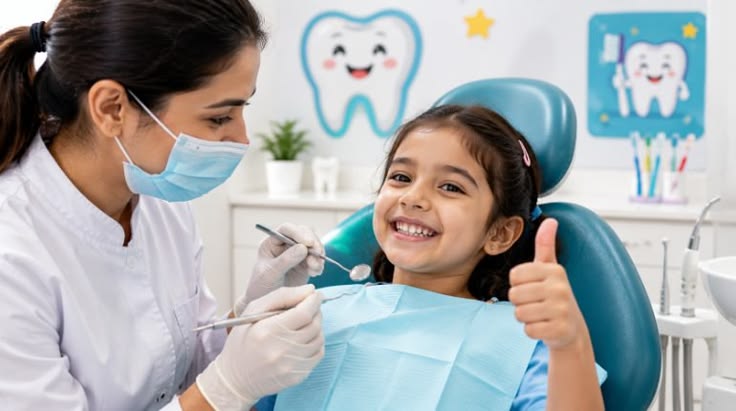
Paediatric dental clinics are specifically designed to be warm, colorful, and less intimidating than adult offices. Dentists use specialized communication techniques to build trust:
Tell-Show-Do: Explaining a tool or procedure in simple, friendly terms, showing how it works, and then performing it [55, 56].
Positive Reinforcement: Praising cooperative behavior and offering small rewards (like stickers) after the visit [53, 55].
Nitrous Oxide ("Laughing Gas"): A safe, mild sedative breathed through a small mask to help anxious children relax during treatment [54, 56].
The American Academy of Pediatric Dentistry (AAPD) recommends that a child visit the dentist by their first birthday or within six months after the eruption of their first tooth [51, 55].
Early visits are primarily "happy visits" designed to check normal development, teach parents proper brushing techniques, and get the child comfortable with the dental chair [51, 55].
Brushing Early: Start cleaning gums with a soft cloth before teeth erupt. Once teeth appear, brush twice a day with a smear-sized amount of fluoride toothpaste (rice-sized for under age 3, pea-sized for ages 3–6) [52, 55].
Watch the Bottle: Avoid putting babies to bed with a bottle filled with milk, formula, or juice, as natural sugars pool around the teeth and cause rapid decay ("baby bottle tooth decay") [51, 54].
Dietary Habits: Limit sticky, sugary snacks and encourage drinking tap water containing optimal fluoride levels [52, 56].