

Page Under Maintenance
This page is currently under maintenance.
Please communicate at the hospital help desk for assistance.
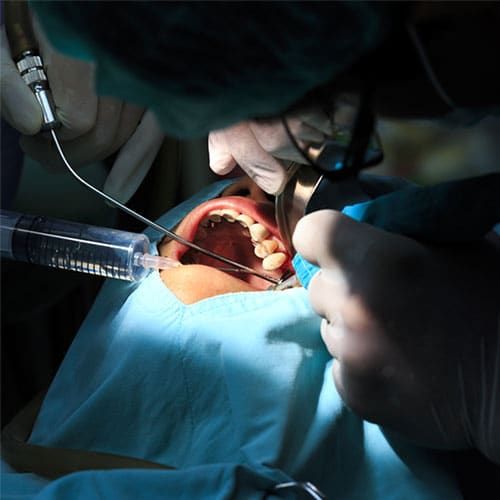
Oral & Maxillofacial Surgery (OMS) is the surgical specialty of dentistry that diagnoses and treats a wide range of diseases, injuries, and defects in the head, neck, face, jaws, and the hard and soft tissues of the oral and maxillofacial region.
Unlike general dental procedures performed in a chair, OMS is a bridge between dentistry and medicine, often involving hospital-based surgical training and the administration of advanced anesthesia [151, 154].
Wisdom Tooth Extraction: Removing third molars that are impacted, causing pain, or threatening to crowd other healthy teeth [152, 156].
Dental Implant Surgery: Precise surgical placement of titanium anchors into the jawbone for patients with complex bone density needs [152].
Corrective Jaw (Orthognathic) Surgery: Repositioning the upper or lower jaw to correct significant bite issues, functional breathing problems (like sleep apnea), or facial asymmetry [151, 154].
Bone Grafting: Regenerating bone in the jaw that has been lost due to tooth extraction or gum disease, providing a stable foundation for future dental implants [152, 155].
Facial Trauma Repair: Emergency treatment of facial fractures, jaw injuries, and lacerations resulting from accidents or sports injuries [153, 154].
Pathology & Biopsy: Removal and diagnosis of suspicious cysts, tumors, or lesions within the mouth and jawbones [151, 153].
Temporomandibular Joint (TMJ) Surgery: Managing severe jaw joint disorders that do not respond to non-surgical physical therapy or splints [154, 156].
Because many oral surgeries are invasive, OMS specialists are uniquely trained in advanced anesthesia. They can safely provide everything from:
Local Anesthesia: Numbing the surgical site.
IV Sedation: Keeping the patient in a "twilight" state where they are relaxed and unaware of the procedure, but breathing on their own.
General Anesthesia: Full unconsciousness, usually reserved for complex hospital-based reconstructive surgeries.
Clinical Assessment & Imaging: Detailed diagnostic work, including 3D CBCT scans to visualize the exact relationship between teeth, nerves, and sinus cavities.
Treatment Planning: Designing a customized surgical approach. In cases of jaw surgery, this involves complex digital mapping and collaboration with an orthodontist.
The Procedure: Performed in either an office-based surgical suite or a hospital operating room, depending on the complexity of the case.
Recovery & Post-Op: OMS specialists provide strict protocols for pain management, diet modification, and swelling control, which are vital for a successful outcome after bone or soft tissue surgery.
You are typically referred to an OMS when the situation involves more than just the surface of the tooth:
Impaction: When teeth are trapped beneath the bone or gum line.
Complex Anatomy: When a procedure risks damaging nerves (like the inferior alveolar nerve) or sinus membranes.
Systemic Complexity: When a patient’s overall health or medication usage makes office-based dental surgery higher risk.
Facial Reconstruction: When the scope of the problem extends beyond the teeth and involves the underlying skeletal structure of the face.
Predictability & Safety: With advanced knowledge of facial anatomy, surgeons can minimize risks of complications like nerve injury or sinus perforation.
Pain Management: Specialized training in anesthesia allows for a much more comfortable surgical experience than is possible with standard local numbing.
Functional Restoration: The focus is not just on the teeth, but on restoring the full functional capability of the jaw and face, which is vital for speaking, breathing, and chewing.