


Page Under Maintenance
This page is currently under maintenance.
Please communicate at the hospital help desk for assistance.
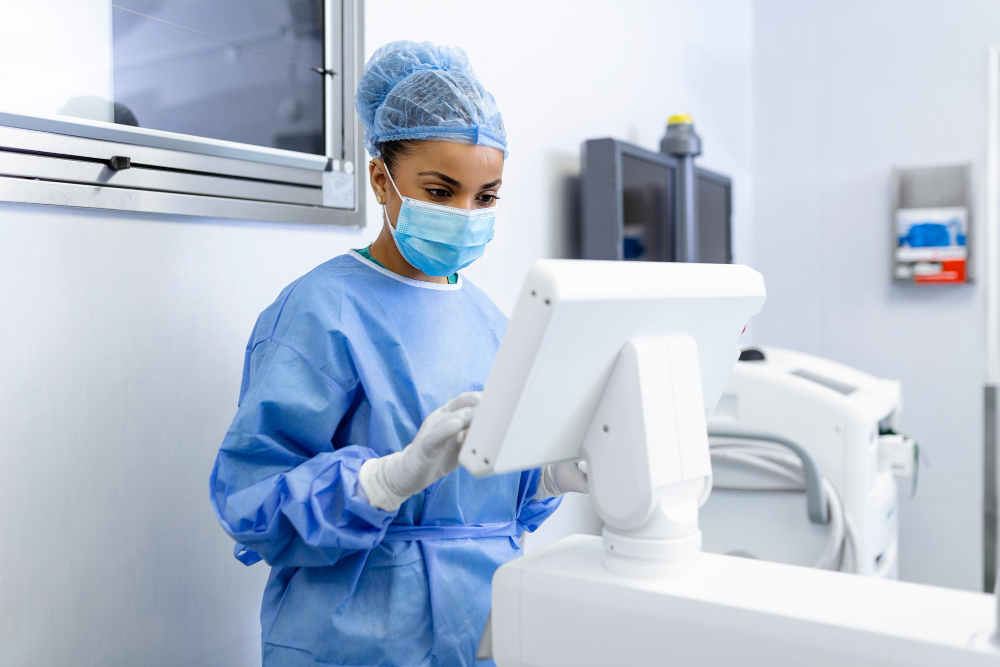
Robotic-assisted surgery is one of the most important developments in contemporary healthcare, and it has completely changed the way procedures are carried out. Robotic surgery, which was formerly thought to be futuristic, is now routinely employed in a variety of specialties, including general surgery, urology, gynecology, cardiology, orthopedics, and oncology.
Robotic surgery is unique because of its remarkable accuracy, which enables surgeons to carry out intricate treatments more precisely, safely, and under control than they could with conventional surgical techniques. Better results, fewer problems, and a quicker recovery for patients are all directly correlated with this precision.
In robotic surgery, a type of minimally invasive surgery, doctors carry out operations using a computer-assisted robotic device. Despite popular belief, robots are not autonomous. Rather, the device accurately converts the surgeon's hand motions into exact, scaled movements of tiny surgical tools inside the patient's body.
The surgeon uses a greatly magnified, three-dimensional camera to see the surgery site while controlling the device from a console. Three essential elements of surgical accuracy are improved by this configuration: eyesight, dexterity, and stability.
Better visualization is a major factor in robotic surgery's increased precision.
Unlike traditional laparoscopic surgery, which depends on two-dimensional imaging, robotic systems give surgeons high-definition, three-dimensional views of the operating field. Surgeons are better able to comprehend the spatial interactions between organs, tissues, nerves, and blood vessels because to this depth perception.
Even the smallest anatomical details are plainly evident when the operative region is magnified up to 10–15 times. This is particularly crucial when working close to fragile tissues like tumors, blood arteries, or nerves, where even a millimeter of inaccuracy might have catastrophic repercussions.
Improved vision results in cleaner dissections, more precise incisions, and better preservation of healthy tissue.
The range of motion of a human hand is replicated, if not exceeded, by robotic surgical instruments.
In contrast to conventional surgical instruments, robotic tools have seven degrees of freedom to rotate and bend, simulating the wrist's natural movement. This makes it possible for surgeons to perform incredibly accurate operations in small or difficult-to-reach places.
The surgeon's hand movements can be reduced by the robotic system. A big hand motion, for instance, can be converted into a small, accurate movement of the instrument tip. When doing complex operations like suturing, nerve-sparing surgery, or tumor excision, this degree of control is crucial.
Small natural hand tremors can occur in even the most skilled surgeons. Even though they are typically negligible, these tremors can impair accuracy during certain delicate treatments.
Tremor-filtering technology, which automatically removes unwanted movements, is a feature of robotic systems. Every movement made inside the body is therefore purposeful, fluid, and steady.
This steadiness is particularly crucial in surgeries involving:
· Blood vessels
· Nerves
· Microsuturing
· Cancer resections
When operating in tight or deep anatomical regions, human hands are limited. These drawbacks are addressed by robotic surgery, which makes it simple for surgeons to handle intricate anatomy.
Robotic instruments can operate efficiently in areas such as:
· The pelvis
· The prostate region
· The heart and chest cavity
· Deep abdominal spaces
Surgeons can complete delicate work without needlessly disturbing tissue thanks to this improved access.
Unlike traditional open surgery, which necessitates larger incisions, robotic surgery usually involves small keyhole incisions.
· More precise entry points
· Reduced tissue trauma
· Less bleeding
· Lower risk of infection
Further increasing surgical accuracy, smaller incisions enable surgeons to precisely target the desired spot without causing any disruption to the surrounding tissues.
Because of their great degree of consistency, robotic systems make sure that every movement is carried out precisely as planned. This is especially helpful for long or complicated processes, where it might be difficult to maintain consistent performance over time.
The device lowers variability and improves outcome predictability since it reacts to the surgeon's directions consistently.
In addition to technology, the surgeon's comfort and concentration are important factors in surgical precision.
Surgeons performing traditional surgery frequently have to stand for extended periods of time in physically taxing positions, which can cause weariness and impair focus. Robotic surgery reduces physical strain by enabling surgeons to work from a sitting, ergonomic console.
· Reduced fatigue
· Improved focus during long procedures
· Better decision-making
· Sustained precision from start to finish
Surgeons are far better equipped to execute precise and controlled maneuvers when they are at ease.
Robotic systems are designed with built-in safety mechanisms that further enhance precision.
The system provides continuous visual feedback, enabling surgeons to monitor every movement in real time and make immediate adjustments when needed.
Robotic platforms can limit instrument movement within predefined safe zones, reducing the risk of accidental damage to nearby organs or tissues.
The precision of robotic surgery offers clear advantages for patients.
· Less blood loss
· Lower infection risk
· Reduced damage to healthy tissue
· Shorter hospital stays
· Less postoperative pain
· Quicker return to daily activities
Precision helps protect vital nerves and muscles during treatments like colorectal, gynecological, or prostate surgery, improving long-term functional outcomes.
In oncological operations, where accuracy is essential to successfully remove tumors while maintaining healthy tissue, robotic surgery is essential.
Surgeons can remove malignant tissue more precisely with robotic assistance, increasing the likelihood of clean surgical margins.
Following cancer treatment, robotic surgery can preserve quality of life by reducing harm to nearby nerves and organs.
Even though robotic surgery provides more precision, the surgeon's ability is still crucial. The surgeon's skills are extended by the robotic system, which serves as a tool.
Robotic technology enhances human potential when utilized by skilled and knowledgeable surgeons, allowing for results that are challenging to accomplish with traditional techniques alone.
Robotic systems are growing increasingly complex as technology advances, combining:
· Artificial intelligence assistance
· Enhanced imaging integration
· Greater automation in repetitive tasks
The foundation of contemporary surgical treatment will be robotic surgery as a result of these developments, which promise even greater levels of safety and accuracy.
A significant improvement in surgical accuracy is represented by robotic surgery. Surgeons may do intricate procedures with unparalleled precision because to improved visualization, better instrument control, tremor removal, and cutting-edge safety measures.
This accuracy benefits patients by resulting in safer procedures, faster recuperation, and improved long-term results. Redefining what is feasible in surgical perfection, robotic technology is bringing the future of precision medicine into today's operating rooms as it develops and becomes more accessible.
Jaslok Hospital offers unparalleled precision and patient safety by combining cutting-edge robotic surgery with the knowledge of highly qualified surgeons and top-notch facilities. Jaslok Hospital continues to set standards for surgical quality by utilizing state-of-the-art equipment and a patient-first philosophy, guaranteeing improved results, quicker recovery, and reliable care at every stage.