


Page Under Maintenance
This page is currently under maintenance.
Please communicate at the hospital help desk for assistance.
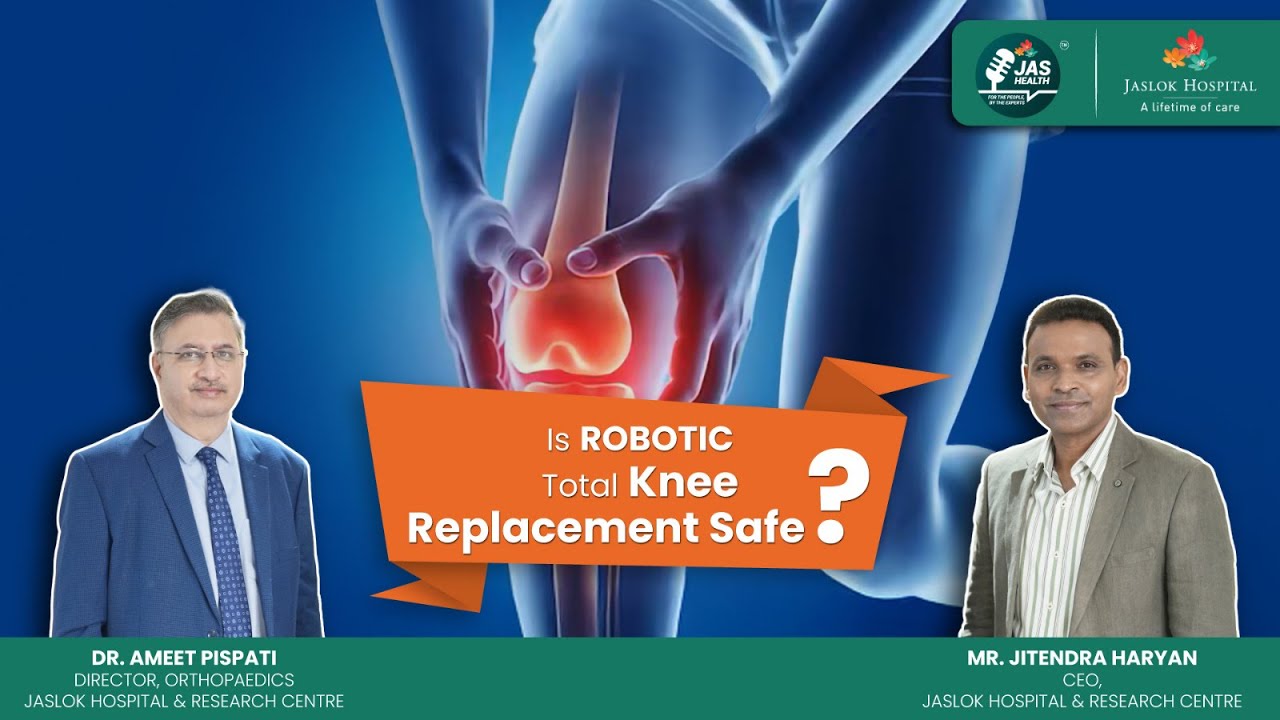
Robotic surgery is often called the future of medicine, and in orthopedics, it has already been in use for over a decade. In this episode of Just Health for the People, a public health awareness initiative by Jaslok Hospital, host Jitendra Hariyan speaks with Dr. Amit Pispati, Director of the Orthopedics Department at Jaslok Hospital, about how robotic-assisted and kinematically aligned knee replacement are transforming patient outcomes.
Dr. Pispati brings over three decades of experience and is internationally trained in joint replacement, sports medicine, and arthroscopic surgery across the UK, Germany, and the United States — including training in kinematically aligned total knee replacement directly under Dr. Stephen Howell, the technique's pioneer, and complex hip and knee procedures at Rush University, Chicago.
While robotic systems have been used in orthopedic surgery for roughly a decade, Dr. Pispati is careful to emphasize a key point: the robot alone doesn't determine outcomes. What truly matters is the experience of the surgeon operating the robot, how it's applied to each patient's specific condition, and how well the treatment plan is tailored to the individual.
Currently, robotic procedures make up only about 10–15%, and at most 20%, of knee surgeries in India — largely due to the high upfront investment cost of robotic systems. However, Dr. Pispati expects this to rise significantly, projecting that 40–50% of surgeries could be robotic within the next 3–4 years as adoption increases.
The core advantage of robotic surgery is precision. Dr. Pispati compares it to the shift from manually piloted aircraft to autopilot-assisted flying — the surgeon remains fully in control at every critical step, but the robot allows for a level of accuracy and customization that wasn't previously possible.
Throughout the process, the surgeon remains in full control — the robot doesn't operate independently; it enhances the surgeon's precision and consistency.
According to Dr. Pispati, robotic-assisted cuts achieve approximately 99.9% precision — a significant leap from traditional freehand techniques.
Beyond precision, robotic-assisted procedures offer several other advantages:
Before surgery, multiple X-rays are taken from different angles and fed into the robotic system. During surgery, a specialized tool is used to map the patient's femur and tibia bones directly, creating a live, individualized model of the patient's knee. This allows the surgeon to build a genuinely personalized treatment plan — a level of customization not possible with conventional, X-ray-only planning.
Dr. Pispati is one of the few surgeons in India trained directly under Dr. Stephen Howell in this specialized technique, which he describes as the single biggest advancement in improving recovery after knee replacement.
Since knee replacement techniques were first developed in the 1970s, bone-cutting protocols have remained largely standardized across patients. Even with robotic precision, if the same standardized plan is followed, patients may achieve accuracy but still experience a knee that feels artificial rather than natural.
Kinematic alignment focuses on restoring each patient's original, pre-disease knee anatomy and natural motion parameters, rather than applying a one-size-fits-all cutting pattern. By analyzing and recreating each patient's unique geometry, the replaced knee tends to feel significantly more natural, with quicker recovery and reduced pain — because, as Dr. Pispati notes, patients are not anatomically identical, and treatment shouldn't be either.
Robotic-assisted knee replacement is considered safe when performed by experienced surgeons at well-equipped facilities. Regarding cost, Dr. Pispati notes that at many hospitals, robotic surgery can add ₹60,000 to ₹1 lakh to the overall procedure cost. At Jaslok Hospital, this additional cost has been kept notably lower — around ₹30,000 to ₹50,000 per patient — making the technology more accessible relative to the significant gains in precision and outcomes.
Dr. Pispati shares a particularly meaningful case: a 50-year-old school teacher in a village in Maharashtra, suffering from severe, crippling knee osteoarthritis. Her situation carried unusually high stakes — she was the sole teacher for 100 students, commuting daily by train and climbing railway bridges to reach her village school. When her condition worsened, she was unable to work, effectively halting education for the entire class, with no substitute teacher available.
She specifically sought a treatment approach that wouldn't require a lengthy, months-long recovery. Following her robotic, kinematically aligned knee replacement, she was walking into her follow-up appointment without any walking aid at just two weeks post-surgery — surprising other patients in the waiting room. By one month, she was climbing the railway bridges again, and the school had resumed normal classes.
Looking ahead, Dr. Pispati describes how growing datasets from robotic surgeries worldwide will soon enable even more sophisticated treatment planning. Within the next 3–5 years, he anticipates robotic systems will be able to show surgeons not just a single recommended plan, but comparative options — such as how top surgeons in the US would approach a specific knee, or how surgeons across a specific region would typically treat it — allowing for even more informed, personalized decision-making.
Robotic-assisted knee replacement, particularly when combined with kinematic alignment, represents a meaningful shift toward truly personalized orthopedic care — offering greater precision, faster recovery, and a more natural-feeling outcome compared to traditional standardized approaches. While the technology carries a modest additional cost, the potential gains in accuracy, reduced complications, and quality of life make it an option worth serious consideration for patients facing knee replacement surgery.
This article is based on an episode of Just Health for the People, a public health awareness initiative by Jaslok Hospital, featuring Dr. Amit Pispati, Director of Orthopedics. Watch the full video here: Robotic Knee Replacement Explained by Dr. Amit Pispati
For consultation regarding knee pain, osteoarthritis, or robotic knee replacement surgery, please reach out to Jaslok Hospital's Department of Orthopedics.