


Page Under Maintenance
This page is currently under maintenance.
Please communicate at the hospital help desk for assistance.
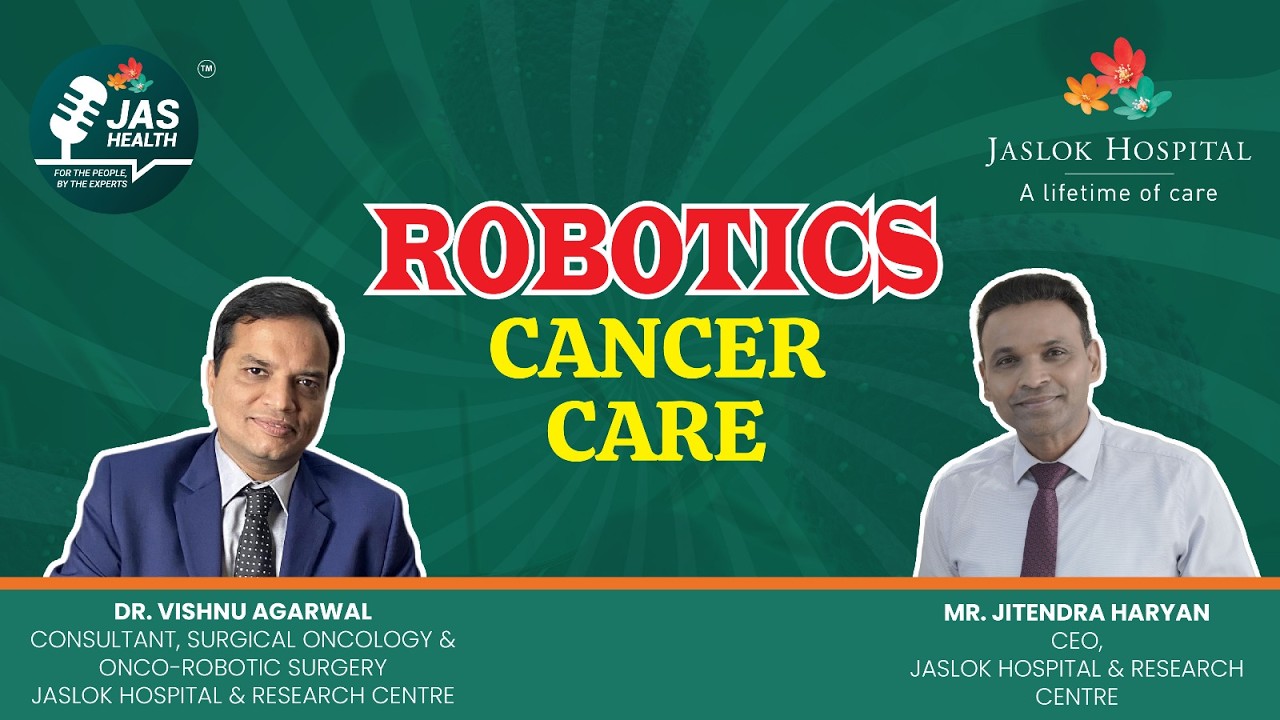
Cancer surgery has transformed dramatically over the past two decades — from large open incisions to minimally invasive, robot-assisted precision. In this episode of Just Health for the People, a public health awareness initiative by Jaslok Hospital, host Jitendra Hariyan speaks with Dr. Vishnu Agarwal, a distinguished oncosurgeon specializing in laparoscopic and robotic surgery, about how technology is redefining cancer care.
Dr. Agarwal trained at Mumbai University and Tata Memorial Hospital, with further international training in South Korea and France. With over 19 years of experience and more than 7,000 surgeries performed, he specializes in gynecological, breast, and colorectal cancers — including performing India's first robotic breast tumor surgery. He is also actively involved in training fellow surgeons in these advanced techniques.
Dr. Agarwal addresses a widespread misconception right away: cancer is not a contagious disease that spreads from person to person. Rather, cancer occurs when a person's own cells become abnormal. While normal cells grow, die, and are naturally replaced, cancer cells grow rapidly and uncontrollably, eventually forming a lump or tumor. The key distinguishing feature of cancer is that this lump doesn't stay confined to one location — it can spread to other parts of the body, a process known as metastasis. If treated at an early stage, however, cancer is highly curable.
Not every cancer patient requires all three treatment modalities. For example:
The specific treatment plan depends heavily on the stage and biology of the cancer at presentation. For instance, an early-stage breast cancer with favorable biology may be treated with surgery alone, while a more advanced stage may require chemotherapy first to shrink the tumor before surgery and radiation follow. Because every case is different, Dr. Agarwal's team reviews cases collectively in tumor boards to determine the optimal treatment path for each patient.
Twenty years ago, cancer surgery was predominantly open surgery — requiring a full incision to access and remove tumors, such as cutting open the abdomen to remove a section of colon. After training internationally in South Korea and France, Dr. Agarwal adopted minimally invasive surgery, where small holes are made in the abdomen for instruments to perform dissection, followed by a small incision to remove the tumor.
Both laparoscopic and robotic surgery fall under this minimally invasive category, but robotic surgery offers distinct advantages over laparoscopic techniques.
One of the most common misconceptions patients have is imagining that robotic surgery means the robot operates autonomously, with the surgeon simply sitting back and watching. Dr. Agarwal is clear: this is completely false. Robotic surgery is entirely under the surgeon's control at all times.
Robotic instruments offer seven degrees of freedom of movement — exceeding even the natural range of motion of the human hand. This makes deep pelvic surgeries (such as prostate, rectal, or uterine procedures) significantly easier to access and perform with precision.
Robotic surgery offers magnification roughly 15 times greater than open surgery and notably higher than laparoscopic surgery — allowing surgeons to clearly see even small blood vessels, reducing the risk of accidental damage and minimizing blood loss.
Because incisions are limited to small ports rather than large cuts, complication rates and blood loss are significantly reduced.
The difference in hospital stay length is substantial:
Not all cancer surgeries benefit equally from robotic assistance. Robotic surgery shows clear advantages particularly in:
Beyond the misconception about robot autonomy, cost is another common concern patients raise. However, Dr. Agarwal notes that when factoring in the significantly reduced hospital stay, ICU costs, and antibiotic use associated with open surgery, the overall cost difference is largely offset. One remaining challenge: insurance companies don't yet fully approve robotic surgery coverage in all cases, which can be an additional consideration for patients.
Robotic surgery isn't just advantageous for patients — Dr. Agarwal notes it significantly benefits surgeons as well:
Gynecological cancers fall into three main categories: uterine (endometrial) cancer, cervical cancer, and ovarian cancer. Robotic surgery currently plays its most established role in endometrial and uterine cancers, where minimally invasive surgery is now the standard of care, offering the same oncological safety (lymph node yield, etc.) as open surgery, but with less blood loss, fewer complications, and lower conversion rates to open surgery.
For ovarian cancer, robotic surgery can be used in very early-stage disease or when a tumor has responded completely to chemotherapy. For cervical cancer, robotic surgery is suitable for early lesions, though not for more advanced cases.
Dr. Agarwal notes that he commonly performs endometrial cancer surgeries robotically, with procedures typically completed in about 1.5 hours, and patients discharged comfortably by the second day.
Colorectal cancer treatment differs based on location:
Dr. Agarwal shares two particularly meaningful cases:
A 30-year-old newly married software engineer was diagnosed with low rectal cancer located just 4 cm from the anal verge. Using robotic surgery, Dr. Agarwal was able to perform deep pelvic dissection and colonic anastomosis, successfully preserving her from a permanent stoma. She has since returned to a completely normal life, working and living without complication.
An 85-year-old woman diagnosed with uterine cancer had a worried family uncertain whether she could safely undergo surgery at all. Following robotic surgery, she recovered remarkably quickly and was discharged within five days — reassuring a family who had feared she might not survive the procedure.
Dr. Agarwal believes robotic surgery — already well-established today — will increasingly become the norm in cancer treatment. As patient expectations shift toward minimal scarring, shorter hospital stays, and faster returns to normal life, robotic surgery is well-positioned to meet these evolving demands.
Dr. Agarwal's core message: a cancer diagnosis is not something to fear, since cancer is highly curable — especially when treated early rather than neglected. Similarly, the prospect of cancer surgery itself shouldn't be a source of dread. With robotic-assisted techniques, patients can often go home within 2–3 days with significantly reduced pain and minimal scarring, rather than the extended hospital and ICU stays historically associated with cancer surgery. Patients are encouraged to discuss robotic surgery options with their doctor, with laparoscopic surgery remaining a solid alternative where robotic surgery isn't available or appropriate.
This article is based on an episode of Just Health for the People, a public health awareness initiative by Jaslok Hospital, featuring Dr. Vishnu Agarwal, oncosurgeon specializing in robotic and laparoscopic cancer surgery. Watch the full video here: Robotic Cancer Surgery Explained by Dr. Vishnu Agarwal
For consultation regarding cancer diagnosis, robotic surgery options, or gynecological and colorectal cancer treatment, please reach out to Jaslok Hospital's Department of Surgical Oncology.