


Page Under Maintenance
This page is currently under maintenance.
Please communicate at the hospital help desk for assistance.
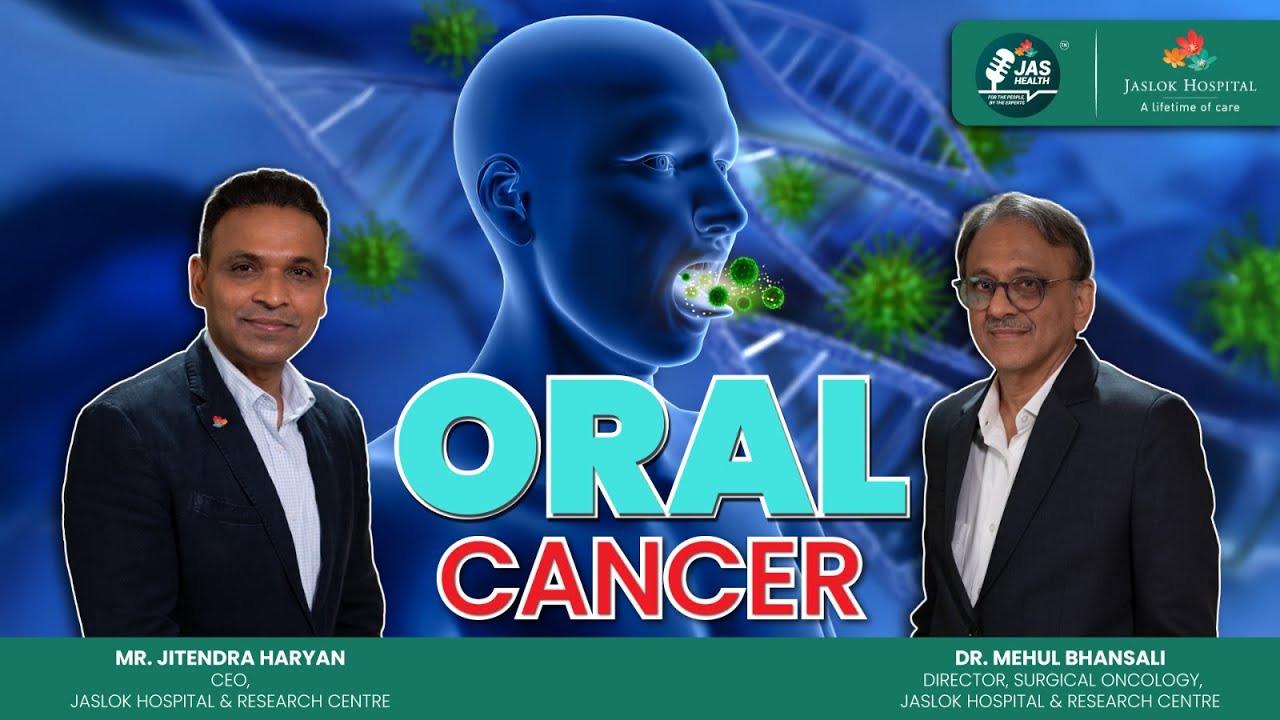
Oral cancer is often called a silent killer — but it's also one of the most preventable and, when caught early, most treatable cancers. In this episode of Just Health for the People, a public health awareness initiative by Jaslok Hospital, host Jitendra Hariyan speaks with Dr. Mehul Bansali, Director of Surgical Oncology at Jaslok Hospital, about early detection, lifestyle risk factors, and timely treatment that can genuinely save lives.
Dr. Bansali brings over 35 years of experience in surgical oncology, trained at the renowned Tata Memorial Hospital, and has performed over 5,000 surgeries to date. He is a gold medalist for best scientific articles and has authored several national and international journal publications.
Oral cancer refers to cancer occurring in the parts of the mouth visible when you open it and look inside — technically a subset of the broader category of head and neck cancers, but the most common type seen in India. The key areas within the oral cavity where cancer most commonly develops include:
Other head and neck cancer sites — such as the oropharynx (the area behind the tongue, including the tonsil region) — are harder to see directly and are classified separately from oral cavity cancer, even though they fall under the same broader category.
The most common type by far is squamous cell carcinoma, accounting for roughly 90% of all oral cavity cancers. Less commonly, cancers can arise from salivary gland tissue in the mouth, and rarely, undifferentiated cancers occur as well.
Dr. Bansali is direct about this: oral cancer is overwhelmingly a habit-driven cancer. The primary risk factors are:
Rarely, patients without any tobacco history may develop oral cancer due to minor contributing factors such as consistently very spicy food or chronic irritation from sharp or broken teeth — though these are considered minor risk factors compared to tobacco and alcohol.
Interestingly, Dr. Bansali notes that genetics appears to play a protective rather than causative role — not everyone who uses tobacco develops cancer, suggesting some individuals have a genetic resistance despite their habits. However, among patients who do develop oral cancer, virtually all report a tobacco or alcohol habit history.
The key takeaway: Oral cancer is largely preventable. Avoiding tobacco and excessive alcohol use dramatically reduces your risk.
Traditionally, oral cancer was most common in people over 40–50, since smoking habits typically began in a person's 20s. However, Dr. Bansali is now seeing cancer develop in patients as young as their late 20s to early 30s, directly linked to tobacco and gutkha habits starting as early as age 12–15 — often beginning in school. Dr. Bansali recently treated a patient around 28 years old, underscoring how earlier habit initiation is leading to earlier disease onset.
Since we routinely look inside our mouths while brushing, oral cancer is technically easy to detect early if you know what to watch for:
Dr. Bansali's clear guidance: if you notice an ulcer, sore, or pain in your mouth, try local treatment for 2–3 weeks. Mouth ulcers are extremely common and usually resolve on their own. However, if the issue doesn't clear up after this period, you must see a specialist without further delay.
The diagnostic process typically involves:
A biopsy is mandatory to confirm cancer, followed by further investigations (CT scan, PET scan, or MRI depending on the affected area) to determine how far the disease has spread.
Head and neck cancer treatment traditionally involves three main approaches: surgery, chemotherapy, and radiotherapy. Historically, surgery has been the primary treatment for oral cancer, though chemotherapy and immunotherapy are increasingly used to shrink tumors before surgery in more advanced cases.
Key factors influencing the treatment approach include:
For Stage III and IV cancers (larger, more difficult-to-operate tumors), chemotherapy is often added first to shrink the tumor, reducing the extent of surgical reconstruction needed. Once the disease has responded and decreased in size, surgery follows, with radiotherapy added afterward based on pathology findings.
Recovery timelines vary based on the extent of surgery:
Regarding eating: for the first 1–2 weeks, patients are typically fed through a nasal feeding tube (Ryle's tube) while the surgical site heals. After about 7–10 days, once healing progresses well, patients can begin liquids — though it typically takes around 2 weeks before a patient can eat normally on their own.
Since oral cancer surgery can affect a significant portion of the face, patient anxiety about appearance is one of the biggest emotional hurdles. Dr. Bansali emphasizes that counseling is a critical part of treatment — while the actual treatment planning might take 5–10 minutes, counseling sessions often take 20–25 minutes to properly address patients' fears about disfigurement, eating ability, and quality of life. Helping patients understand that a cancer diagnosis is not "the end of the story" is essential to preparing them for treatment.
Robotic surgery is increasingly being used for specific, harder-to-reach areas — particularly tonsil-area cancers and base of tongue cancers — especially at early (Stage I) disease stages. Robotic-assisted surgery in these cases offers notable benefits, including faster recovery and earlier hospital discharge.
Recurrence risk varies significantly by stage:
When recurrence does occur, approximately 10–20% of cases remain surgically operable, depending on the recurrence location and surgical accessibility. For non-operable recurrences, treatment typically shifts to chemotherapy, and if radiation wasn't part of the original treatment, chemo-radiotherapy may be added. Immunotherapy is emerging as an increasingly established treatment option, with promising outcomes for roughly 10–20% of recurrent cases.
Dr. Bansali is firm on one point: patients should completely avoid returning to tobacco and alcohol after treatment, even occasionally or socially. While he acknowledges the difficulty of maintaining strict limits ("just once in a while"), he consistently advises against any resumption of these habits, given the risks to both the patient and their family.
Both act through chronic irritation of the oral mucosa (the inner lining of the mouth). Over a long period, this repeated irritation can contribute to cancer development. However, Dr. Bansali is careful to note that spicy food is a minor factor compared to tobacco and alcohol — Indian dietary habits naturally include significant spice consumption, and this alone is not a major cause for concern in moderation.
Dr. Bansali stresses that oral cancer prevention needs greater national focus — even at major institutions like Tata Memorial and Jaslok Hospital, oral cavity cancer accounts for roughly 50% of head and neck cancer cases seen, despite being highly preventable.
Key prevention strategies include:
Oral cancer is one of the most common — and most preventable — cancers seen in India today. Dr. Bansali's core message: live well, eat well, and avoid tobacco and excessive alcohol use. Early detection through simple self-examination, prompt attention to non-healing ulcers, and reduced exposure to known risk factors can make an enormous difference in outcomes.
This article is based on an episode of Just Health for the People, a public health awareness initiative by Jaslok Hospital, featuring Dr. Mehul Bansali, Director of Surgical Oncology. Watch the full video here: Oral Cancer Awareness Explained by Dr. Mehul Bansali
For consultation regarding oral health, non-healing mouth ulcers, or oral cancer treatment, please reach out to Jaslok Hospital's Department of Surgical Oncology.