


Page Under Maintenance
This page is currently under maintenance.
Please communicate at the hospital help desk for assistance.
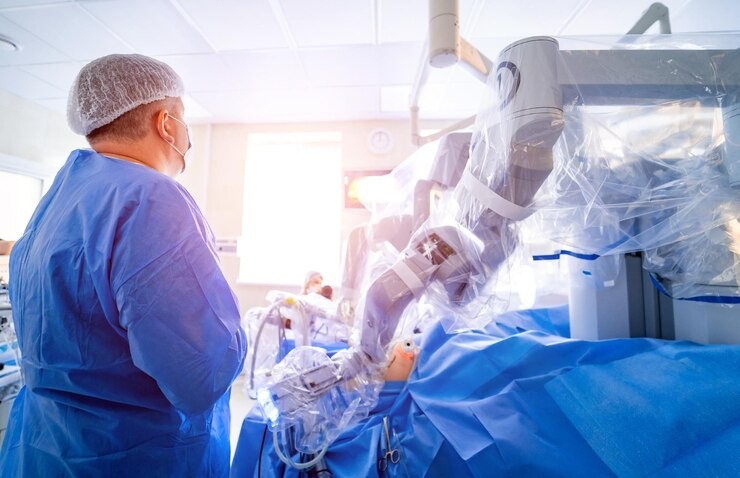
The landscape of modern medicine has shifted dramatically with the introduction of advanced surgical technologies. Today, Robotic surgeons are playing a critical role in transforming soft tissue surgery, making intricate procedures more precise and controlled. Rather than replacing human expertise, robotic platforms enhance the surgeon’s abilities by providing magnified 3D visualization, tremor filtration, and expanded instrument dexterity. Let’s explore how these systems function, why they matter, and what they mean for patients undergoing complex surgical interventions.
Robotic-assisted procedures have steadily gained acceptance across global healthcare systems. What began as experimental innovation has now become a standard option in many tertiary hospitals. The growth is driven by improved patient outcomes, enhanced surgical precision, and the increasing demand for minimally invasive techniques.
The development of robotic surgery emerged from limitations seen in open and laparoscopic procedures. Traditional open surgery required large incisions and extended recovery times, while laparoscopy improved access but restricted instrument mobility and visualization. Robotic platforms addressed these gaps by introducing wristed instruments, high-definition three-dimensional imaging, and motion scaling. Over time, software algorithms and imaging systems have advanced further, allowing greater control in delicate anatomical regions. This technological progression has positioned robotic platforms as a transformative extension of surgical expertise.
Healthcare institutions evaluate technology based on patient outcomes, operational efficiency, and long-term sustainability. Robotic systems contribute to reduced complication rates, shorter hospitalization periods, and improved surgical accuracy in complex cases. Although acquisition costs are substantial, hospitals often offset expenses through improved throughput and patient satisfaction metrics. Additionally, offering robotic-assisted surgery enhances institutional reputation, attracting both experienced surgeons and patients seeking advanced treatment options. Strategic investment in robotic platforms reflects a commitment to innovation and quality care.
As evidence supporting robotic surgery grows, international surgical standards continue to evolve. Training curricula increasingly incorporate robotic modules to ensure future surgeons develop console proficiency. Regulatory bodies have established credentialing requirements to maintain safety and competency. Clinical studies demonstrating favorable recovery profiles further accelerate global acceptance. Consequently, robotic assistance is no longer viewed as experimental but rather as an integrated component of modern surgical practice across multiple specialties.
Soft tissue procedures involve delicate anatomical structures such as organs, vessels, and nerves. These tissues require precise handling to prevent complications. Robotic systems are particularly advantageous in confined surgical fields where stability and visualization are paramount.
Soft tissue structures are highly vascular and often situated near critical nerves. Even minimal deviation during dissection can impact postoperative function. Robotic platforms enhance surgical precision by offering motion scaling, tremor elimination, and articulated instruments capable of refined manipulation. Surgeons benefit from magnified three-dimensional visualization, enabling clearer differentiation between tissue planes. This heightened accuracy supports delicate suturing and nerve preservation, particularly in oncologic and reconstructive procedures where margins and structural integrity are essential.
Minimally invasive access is one of the defining strengths of robotic surgery. Instead of large incisions, surgeons operate through small ports that reduce tissue trauma. Smaller incisions generally correlate with lower infection rates, decreased postoperative pain, and shorter recovery times. Robotic articulation allows complex maneuvers within narrow spaces that would otherwise require extensive exposure. This combination of minimal access and enhanced dexterity significantly improves the patient experience during and after surgery.
Clear visualization determines surgical accuracy, especially within dense anatomical regions. Robotic systems provide high-definition, three-dimensional magnification that enhances depth perception. Surgeons can assess vascular structures, tissue layers, and subtle anatomical variations with remarkable clarity. This improved perspective reduces the likelihood of inadvertent injury and supports confident navigation within confined spaces. Enhanced visualization ultimately strengthens surgical precision in complex soft tissue environments.
A robotic surgical platform consists of interconnected components designed to function seamlessly during procedures. Each element contributes to precision, control, and safety.
The surgeon operates from a console equipped with hand controls, foot pedals, and a high-definition viewer. Movements at the console are translated into scaled, precise actions by robotic instruments. This ergonomic setup reduces physical strain compared to standing over an operating table for extended periods. By maintaining a stable seated position, surgeons can concentrate fully on fine motor movements, enhancing consistency during lengthy procedures.
Robotic arms serve as mechanical extensions of the surgeon’s hands. Equipped with wristed instruments, they provide a range of motion exceeding natural human capability. These instruments rotate and articulate with exceptional stability, enabling precise cutting, suturing, and dissection. Tremor filtration further refines motion, ensuring that unintended hand movements do not transfer to the surgical field. This mechanical precision is particularly valuable in confined soft tissue regions.
The imaging system offers magnified three-dimensional views of the operative field. Enhanced depth perception allows surgeons to identify tissue boundaries and vascular structures accurately. High-definition cameras deliver consistent clarity, even in low-light internal environments. The combination of magnification and stable imaging strengthens situational awareness, enabling careful manipulation of delicate tissues during complex procedures.
Understanding procedural flow clarifies how robotic systems integrate into surgery. Each stage follows strict protocols to ensure safety and efficiency.
The Robotic surgery process begins with patient positioning and anesthesia induction. Surgeons create small incisions to insert trocars, which function as entry ports for robotic instruments. After docking the robotic arms, the surgeon transitions to the console, where hand movements control instrument articulation. The system filters tremors and scales motion for precision. Upon completing dissection or reconstruction, instruments are withdrawn and incisions are closed. This structured workflow ensures consistent procedural execution.
Docking involves carefully positioning robotic arms relative to the patient’s anatomy. Proper alignment ensures optimal instrument range and minimizes mechanical strain. The surgical team collaborates closely during this phase to confirm stability and avoid collisions between arms. Precise docking enhances maneuverability, allowing the surgeon to operate efficiently within confined spaces.
At the conclusion of the operation, surgeons evaluate the operative field for hemostasis and structural integrity. Robotic instruments facilitate meticulous suturing where required. Once the surgical objective is achieved, the robotic arms are disengaged and removed. Small incisions are closed using minimal sutures, contributing to reduced postoperative discomfort and faster recovery.
Safety remains central to robotic-assisted procedures. Rigorous training and system protocols safeguard patient well-being.
Surgeons must complete specialized training before independently performing robotic procedures. This pathway includes simulation modules, supervised cases, and competency assessments. Continuous education ensures familiarity with evolving software and hardware advancements. Structured credentialing protects patient safety while maintaining high professional standards.
Robotic systems undergo diagnostic checks before every procedure. Backup instruments and contingency strategies remain available should technical issues arise. An experienced surgical team supports console operation throughout the procedure. These measures ensure that patient safety is never compromised.
Robotic surgery recovery often reflects reduced tissue trauma and improved healing dynamics. Patients typically experience less postoperative discomfort and shorter hospital stays. Smaller incisions reduce infection risk and scarring. Early mobilization supports circulation and respiratory function, enhancing overall recovery. Long-term outcomes in soft tissue oncology frequently demonstrate accurate margin control. While individual results vary, patient satisfaction rates remain consistently favorable following robotic-assisted procedures.
Related: Is Robotic Surgery Right for You? What Patients Should Know
The integration of Robotic surgeons into soft tissue surgery represents a sophisticated evolution in operative care. By merging human expertise with mechanical precision, robotic systems improve visualization, stability, and recovery outcomes. Although cost and training requirements present challenges, continuous innovation continues to refine its impact. As technology advances, robotic-assisted procedures are poised to become even more central to modern surgical practice.