


Page Under Maintenance
This page is currently under maintenance.
Please communicate at the hospital help desk for assistance.
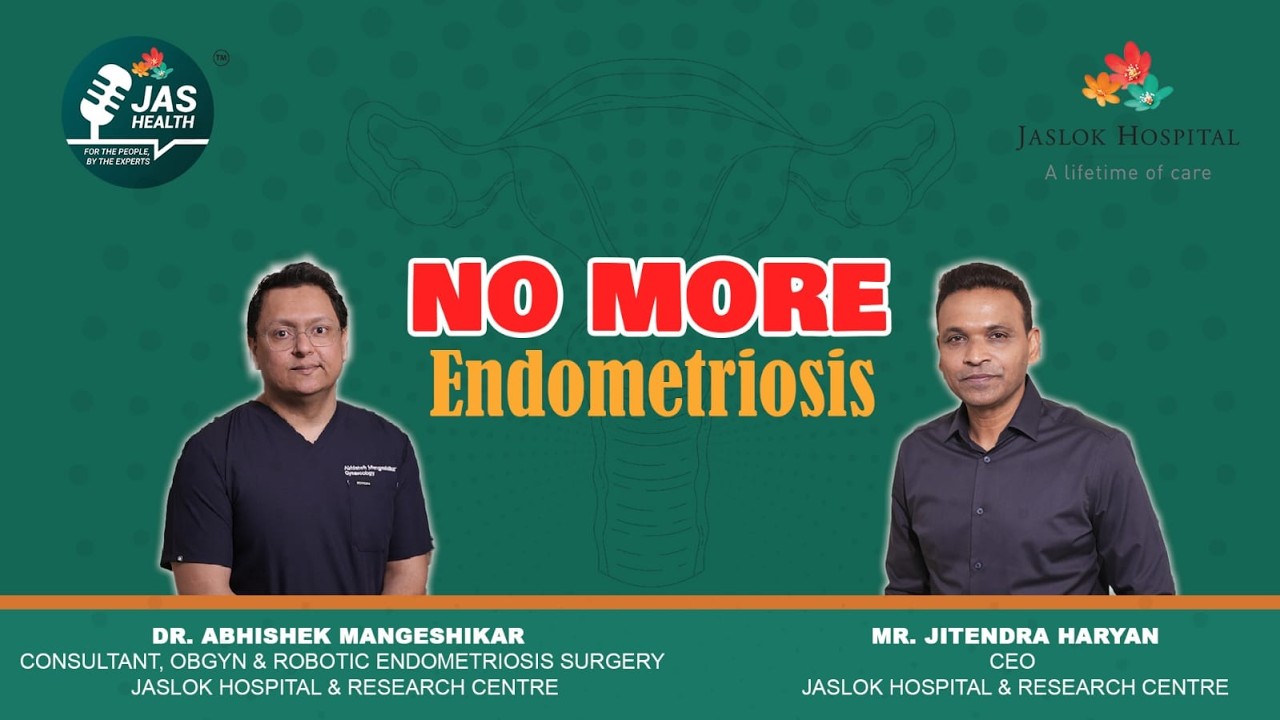
Endometriosis is more common than diabetes, yet it remains widely misunderstood, underdiagnosed, and often dismissed as "normal period pain." In this episode of Just Health for the People, a public health awareness initiative by Jaslok Hospital, host Jitendra Hariyan speaks with Dr. Abhishek Mangeshikar, an expert excision surgeon trained in advanced gynecologic endoscopy and minimally invasive surgery, who has performed nearly 3,000 procedures and led a multidisciplinary endometriosis practice for over a decade.
Endometriosis affects approximately one in seven to one in ten women worldwide, making it more prevalent than diabetes — though 27 documented cases have also been reported in men. It is a globally prevalent condition that doesn't discriminate by socioeconomic status, race, or geography.
The condition involves tissue resembling the inner lining of the uterus (the endometrium) growing outside the uterus. Importantly, this tissue can grow almost anywhere in the body — not just in the pelvis. Dr. Mangeshikar notes cases involving the abdominal wall, bladder, diaphragm, chest, and even rare cases in the wrist, eye, and brain.
One of the most damaging beliefs — often instilled from adolescence — is that severe period pain is simply "part of growing up" or "becoming a woman." Dr. Mangeshikar is emphatic: any period pain that is debilitating enough to cause missed school, work, or social activities deserves medical attention, not normalization.
This cultural normalization, combined with the myth that pregnancy will "solve" the problem, contributes to a global diagnostic delay of 7 to 10 years on average from symptom onset to actual diagnosis.
Dr. Mangeshikar describes endometriosis as "a specialist disease trapped in a generalist specialization." It is, in his words, more complex than most cancers, yet typically managed within general gynecology rather than by dedicated specialists. He notes a troubling pattern: while gynecologists refer cancer cases to specialists quickly, endometriosis often follows a slower, less rigorous path — starting with denial, then basic pain medication, and eventually redirecting the conversation toward fertility rather than addressing the disease itself.
Understanding endometriosis requires recognizing it rarely exists as a single, isolated problem:
This distinction matters enormously for outcomes: when only the chocolate cyst is treated (as in general gynecological care), recurrence rates range from 50–80%. When all three subtypes are properly identified and treated by specialists, recurrence rates drop to just 5–10%.
Endometriosis symptoms extend well beyond menstrual pain and can occur before, during, or after periods, including during ovulation. Depending on which organs are affected, symptoms can include:
Several factors contribute to the persistent invisibility of this disease:
Dr. Mangeshikar notes that Jaslok Hospital has developed one of the most comprehensive endometriosis MRI protocols in the country, allowing him to plan surgical procedures in detail before a patient even reaches the operating theatre.
On average, patients see 5 to 10 doctors and often undergo multiple surgeries before reaching a specialist. Dr. Mangeshikar has treated patients with up to 16 prior surgeries. A common problematic pattern: patients are prescribed birth control or told to pursue pregnancy, sometimes pushed into IVF procedures that can actually worsen the underlying disease through hormonal stimulation — rather than receiving comprehensive surgical treatment first.
Dr. Mangeshikar is direct in debunking persistent misconceptions:
Endometriosis can impact fertility through multiple mechanisms:
Importantly, Dr. Mangeshikar cautions that pursuing IVF without first treating the underlying disease can worsen it — hormonal stimulation from IVF protocols can exacerbate inflammation, and the egg retrieval process itself can create additional micro-adhesions. He emphasizes close collaboration with fertility teams, including considering egg freezing in appropriate cases to preserve fertility before surgery.
Years of unresolved, dismissed pain take a significant mental health toll — particularly for adolescents who feel isolated watching peers navigate periods without similar struggles. Dr. Mangeshikar describes the emotional relief many patients feel upon finally receiving a diagnosis — validation that the pain was never "in their head."
A referenced 2019 BBC study of roughly 40,000 endometriosis patients found reports of stunted career and academic progress, relationship strain, with 50% reporting some form of self-harm and 1% having attempted suicide. Pain during intercourse can also place significant strain on relationships, though Dr. Mangeshikar notes encouragingly that many partners today arrive at consultations well-informed and supportive.
Dr. Mangeshikar strongly advocates for full excision surgery — removing disease from its roots, similar to the surgical approach used for cancer, rather than simply burning or ablating visible lesions. This distinction matters because:
Excision surgery, by contrast, offers a dramatically lower recurrence rate compared to ablation-based approaches.
Jaslok Hospital treats patients from across the globe — including the Middle East, UK, and Canada — for complex endometriosis cases. Dr. Mangeshikar explains that with an estimated 250 million patients worldwide (45 million reported in India alone) and only around 300 surgeons globally specializing in endometriosis surgery (with just 40–50 capable of handling advanced disease), patients increasingly need to seek out specialist expertise regardless of geography — and India has emerged as a leading destination for this highly specialized surgical care.
Recognizing that endometriosis is not solely a gynecological disease, Jaslok Hospital's approach involves close collaboration across multiple specialties:
This model — inspired by multidisciplinary approaches originally developed for ovarian cancer care — treats the whole patient, not just the disease.
Dr. Mangeshikar shares a particularly complex recent case: a patient from the Congo who had previously undergone an open surgery abroad that was abandoned once surgeons saw the extent of disease. Upon evaluation at Jaslok, the team discovered an aggressive endometriosis mass that had caused kidney failure on one side, invaded half the bladder, half the vagina, and extended into the rectum.
Using robotic surgery, a coordinated team — including a urologist (who removed the affected kidney), Dr. Mangeshikar (who mobilized the pelvis down to the sciatic nerve and resected half the bladder), and a colorectal surgeon (who rejoined the bowel) — completed a 12-hour procedure. Remarkably, the patient avoided a permanent colostomy bag entirely, was discharged within a week, had her catheter removed in 10 days, and her stent removed a month later.
Dr. Mangeshikar challenges the traditional assumption that advanced endometriosis surgery requires removing the uterus and ovaries. Since endometriosis by definition exists outside the uterus, there's typically no justification for uterus removal unless separate conditions like adenomyosis or fibroids are also present. His approach prioritizes treating the disease itself — preserving fertility wherever possible for patients who desire it.
Dr. Mangeshikar's practical advice:
Endometriosis is a widespread, often invisible disease that deserves far more clinical attention and public awareness than it currently receives. Painful periods are not something to simply endure, cyst removal alone is not comprehensive treatment, and infertility is not the disease's only — or even most common — consequence. With proper specialist care, comprehensive excision surgery, and a multidisciplinary treatment approach, patients can achieve significantly better outcomes, lower recurrence rates, and improved quality of life.
This article is based on an episode of Just Health for the People, a public health awareness initiative by Jaslok Hospital, featuring Dr. Abhishek Mangeshikar, expert excision surgeon specializing in endometriosis. Watch the full video here: Endometriosis Explained by Dr. Abhishek Mangeshikar
For consultation regarding endometriosis symptoms, diagnosis, or excision surgery, please reach out to Jaslok Hospital's endometriosis care team.