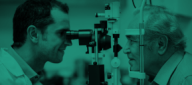
Before a surgeon replaces the cloudy lens in your eye with a clear artificial one, they need a "blueprint" of your eye’s unique dimensions. Ocular Biometry is the process of measuring the eye to calculate the exact power of the Intraocular Lens (IOL) required to give you the best possible vision.
Think of it as getting fitted for a custom suit, but for your sight. There are two primary ways to do this: the traditional A-scan and the high-tech IOLMaster.
1. What is it? (Overview & Common Names)
Biometry uses either sound waves or light to measure the Axial Length (the distance from the front to the back of the eye) and the curvature of the cornea.
- A-Scan (Ultrasound Biometry): Uses high-frequency sound waves. It can be "Applanation" (where a probe touches the eye) or "Immersion" (where a small water shell is placed over the eye).
- IOLMaster (Optical Biometry): Uses laser light (Partial Coherence Interferometry) to measure the eye without ever touching it. It is widely considered the "Gold Standard" for accuracy in modern cataract surgery.
Common Names: IOL Power Calculation, Eye Measurement, Ocular Biometry.
2. Comparison: A-Scan vs. IOLMaster
|
Feature
|
A-Scan (Ultrasound)
|
IOLMaster (Optical)
|
|
Technology
|
Sound waves
|
Laser light
|
|
Contact
|
Touching the eye (or water bath)
|
Non-contact (No touch)
|
|
Accuracy
|
High (in skilled hands)
|
Extremely High (more precise)
|
|
Patient Comfort
|
Requires numbing drops
|
Very comfortable
|
|
Limitation
|
User-dependent
|
Cannot "see" through very dense cataracts
|
3. When is this required?
Biometry isn't a routine screening; it is a specialized pre-operative step. You will need this if:
- Cataract Surgery is Planned: To determine which lens power will replace your natural lens.
- Refractive Lens Exchange: If you are choosing surgery to eliminate the need for glasses even without a cataract.
- Monitoring Myopia: Sometimes used in children to track the physical growth of the eye in "Progressive Myopia."
4. Associated Conditions
- Cataracts: The clouding of the natural lens.
- Myopia (Nearsightedness): Often associated with a longer-than-average axial length ($L$).
- Hyperopia (Farsightedness): Associated with a shorter axial length.
- Astigmatism: Where the cornea is shaped more like a football than a basketball.
5. The Science of the "Blueprint"
Surgeons use the measurements from these devices in complex mathematical formulas to find the IOL power ($P$). A classic example is the SRK/T formula:
$$P = A - 2.5L - 0.9K$$
- $A$: A constant specific to the type of lens being implanted.
- $L$: Axial length of the eye (measured by A-scan or IOLMaster).
- $K$: Keratometry (the curvature of the cornea).
6. Am I Eligible for This Procedure?
- IOLMaster Candidates: Most patients. It is preferred because it is faster and does not require touching the eye, which eliminates the risk of "compressing" the cornea and getting an inaccurate reading.
- A-Scan Candidates: If you have a very dense ("mature") cataract or significant bleeding inside the eye, the IOLMaster's laser may not be able to pass through. In these cases, the "seeing" power of ultrasound (A-scan) is necessary to get the measurement.
7. Pre and Post-Care Requirements
Pre-Care:
- Contact Lens Holiday: This is the most important rule. Contact lenses temporarily "mold" your cornea. You must stop wearing soft contacts for 1 week and hard (RGP) contacts for 3 weeks before the measurement to ensure your eye has returned to its natural shape.
- No Numbing Required for IOLMaster: Since it doesn't touch the eye, you don't even need drops.
Post-Care:
- Immediate Activity: You can return to your normal routine immediately.
- Slight Blurriness: If numbing drops were used for an A-scan, your vision might be slightly blurry for an hour, but there are no major restrictions.
8. Hospitalization Timeline
- Setting: Outpatient diagnostic clinic or the ophthalmologist's office.
- Procedure Time: * IOLMaster: 5 to 10 minutes.
- A-Scan: 15 to 20 minutes.
- Hospital Stay: None. You leave as soon as the measurements are saved.
9. Benefits of Precise Biometry
- Refractive Predictability: Modern biometry allows many patients to achieve "20/20" vision without glasses after surgery.
- Customization: It allows for the use of Premium Lenses (Toric lenses for astigmatism or Multifocal lenses for reading).
Safety: Non-contact (IOLMaster) measurements carry zero risk of infection or corneal abrasion.